Photo: Daniel X. O'Neil / Wikimedia Commons
The Restart That Starts Everything
The girls game has no faceoff. Play starts, restarts after every goal, and restarts each period with the draw: two players standing in the center circle, sticks pressed back to back with the ball between them, waiting for the whistle. The draw is not a ceremony. It is a contested skill with its own specialists, its own statistic, and its own foul list, and teams that win it get extra possessions that cost them nothing.
The Setup, Step by Step
- The two draw takers meet at the center of the circle. Each stands with one foot toeing the center line, on her own side.
- Each holds her stick above her hip, parallel to the center line, with the back of her stick head against the back of her opponents. Her own stick sits between the ball and the goal she is defending.
- The official places the ball between the two stick heads and checks that both players are set and still.
- The other players take their positions (below) and may move until the whistle, but may not enter the circle or cross the restraining lines early.
- On the whistle, both players draw their sticks up and away in one motion. The ball must rise higher than both players heads. A ball that dribbles out low is an illegal draw and is whistled back.
Where Everyone Else Stands
Under the USA Lacrosse youth structure, a maximum of five players from each team may be between the restraining lines during the draw: the draw taker, and teammates positioned around the edge of the center circle ready to run onto the ball. Everyone else stays behind her own restraining line until possession is won. School and college books set their own circle and restraining line limits, but the shape is the same everywhere: a small group contests the ball in the middle, and the rest of the field waits for the outcome.
Circle players win as many draws as draw takers do. Their job is to read the flight, box out legally with position, and be first to a ball that rarely goes where the taker aimed it.
Illegal Draws
| Fault | Result |
|---|
| Moving the stick before the whistle, or resetting after the official has set the sticks | Free position to the other team |
| Drawing down or out instead of up and away | Illegal draw; free position to the other team |
| Ball fails to rise above the players heads because of how it was drawn | Redraw if neither player is at fault; free position if one is |
| Stepping into the circle or crossing the restraining line before the whistle | Free position to the other team |
| Both players draw illegally, or the official cannot tell who fouled | A throw (alternate possession style restart) at the spot in most books |
Three Ways to Win a Draw
| Technique | What the taker does | When it works |
|---|
| To herself | Flicks the ball up and forward and runs onto it | Against a slower opponent; the classic self draw |
| To a teammate | Directs the ball to a spot where a circle player is already moving | Against a strong taker; turns the draw into a set play |
| To space | Puts the ball high and long and lets speed decide | When her team is faster around the circle than the opponent |
Draw control, the statistic, is credited to the player who gains possession from the draw, whether that is the taker or the teammate who comes away with the ball. Coaches track team draw percentage the way other sports track faceoff percentage, because over a season the team that wins draws simply gets more chances to score.
Scouting the Other Taker in the First Four Draws
Coaches treat the opening draws of a game as information, and this section is a coaching convention rather than a rule. Most takers have a default direction: the ball leaves toward the same side, at roughly the same height, whenever the first plan works. The circle players who watch the first four draws instead of chasing them learn that default quickly. By the second quarter, the defense of a draw is mostly anticipation: shade the side the ball keeps visiting, station the fastest circle player where the flight usually lands, and make the taker win with her second option instead of her favorite.
Takers counter by building exactly that second option. A taker who can go to herself in the first quarter and to a teammate in the third is much harder to shade, because the circle defense has to respect both flights at once. This is why draw practice at strong programs looks repetitive from the stands. The reps are not about one perfect motion. They are about owning two or three flights so well that the choice can wait until the sticks are already set.
The Draw With Two Minutes Left
A late draw with the score tied or one goal apart changes value, not mechanics. The taker still needs the ball to rise above both heads, and the circle rules still apply. What changes is the cost of the illegal draw. A stick that moves early in the first quarter gives away one free position. The same twitch late in the game gives away the possession that may decide it, which is why experienced takers slow their breathing and set their sticks earlier when the game tightens.
Coaches also change the circle in late situations, and the change is a convention worth knowing as a spectator. The best ground ball player on the team replaces a faster but less secure teammate on the circle, because a late draw that pops loose is a ground ball contest before it is anything else. If your team wins the clamp but loses the scrum, the draw still counts as lost in the statistic and in the game.
What Changes at the Youth Levels
The draw itself looks the same at 12U and 14U as it does in the school game: two takers, backs of the sticks together, ball placed between them by the official. The differences sit around it. Youth fields are smaller at the youngest levels, rosters rotate more, and many youth programs ask several players to take draws across a season so the skill spreads through the roster instead of belonging to one specialist. The five player limit between the restraining lines in the youth structure also means the circle is less crowded than a new spectator expects, and the ball travels farther relative to the number of players chasing it.
For parents, the useful youth takeaway is that draw success at 10U is mostly about the circle, not the taker. Young takers pop the ball up with limited direction, and the player who reads the flight and boxes out legally comes away with most possessions. Praise the reader, not just the taker, and the stat sheet will make more sense.
How Draw Practice Is Usually Built
Programs that develop draw units follow a simple weekly shape, offered here as a coaching convention. Early in the week, takers work alone on motion and direction: sets of draws to a called target, self, left, or right, with a coach checking that the ball clears head height every rep. Midweek, circle players join and the work becomes flight reading and legal box outs. Late in the week, the unit runs live draws against the scout look, the default direction the next opponent showed on film or in the first meeting.
The planner below builds sessions from the established girls draw bank in this site data: placement reps, circle ground ball scrums, fast breaks off a won draw, and recovery work after a lost one. A balanced week touches all four, because the draw is four skills wearing one name.
Choosing Who Takes the Draw
Programs choose a draw taker on a short list of traits, and the list surprises families who assume height decides it. Timing against the whistle matters most, because the motion starts on sound and a late start concedes the first touch. Wrist strength and snap come next, since the ball has to climb above two raised sticks in one motion. Height helps reach at the top of the flight, but a shorter taker with a faster first step onto her own pop up wins draws that a taller, slower taker watches.
The second trait is what happens after the whistle. The taker is also a midfielder, and a specialist who wins the ball but cannot play the possession that follows costs her team a substitution pattern. Strong programs develop two takers with opposite default directions, so the choice itself becomes a scouting problem for the opponent.
A Four Draw Scouting Card, Filled In
Scouting notes only help when they are written in a form a player can use at the next whistle. Here is a filled card from a typical school game, kept by the backup draw taker on the bench, showing the level of detail that actually changes decisions.
Draw one, opening: opponent holds her stick low and pushes forward early. Ball squirts toward her circle players on the left. Note written: wins by pushing, not lifting. Draw two: same push, ball again left, our left circle player beaten to it by half a step. Note: shade left, start the left circle player one step closer to the arc. Draw three: our taker changes to a lift and pull toward herself, wins clean, because the opponent was leaning forward expecting another push battle. Note: she commits her weight early, so the self draw is open. Draw four: opponent adjusts, stands taller, ball pops straight up, scrum won by our right circle player who boxed out first. Note: when she stands tall the ball goes up, so circle players should hold position instead of chasing.
Four draws produced four usable facts: the opponent pushes, she leans, the ball favors the left when she pushes, and height beats chase on the pop up. None of that required video. It required one person watching only the draw while everyone else watched the game, and a card simple enough to fill in during the walk back to the restraining line. Teams that keep this card for a full season build a league wide file on opposing takers, and the second meeting with a team plays very differently from the first.
Frequently Asked Questions
Why is it called a draw if nobody is facing off on the ground?
The name describes the motion: the two players draw their sticks up and away from each other, pulling the ball into the air. The girls game kept the standing draw while the boys game developed the ground level faceoff.
How often does the draw happen?
At the start of the game, at the start of each period or half under the local format, and after every goal. In a high scoring game the draw can happen twenty or more times, which is why specialists matter.
Can anyone take the draw?
Any field player can, but the role usually belongs to a midfielder, often the center, because she must also play the possession that follows. Height, timing, and wrist strength matter more than size.
What is a good draw control percentage?
There is no official benchmark in any rule book. Draw control is a team statistic, credited on each draw to the player who gains possession, and the honest reading is comparative: a team above half is winning more restarts than it loses and earning extra possessions, while a team well below half is defending more often than it attacks. Coaches care less about the exact number than about the trend across a season and about which circle matchup is producing it.
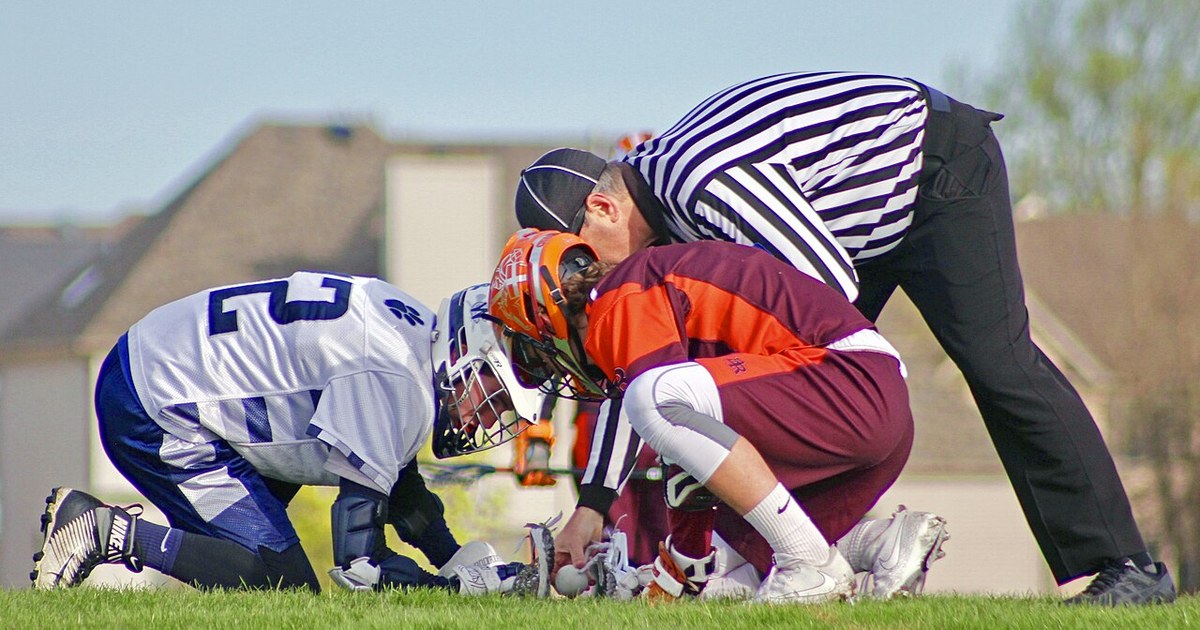
How is the girls draw different from the boys faceoff?
Everything about the posture. Girls takers stand upright with sticks held above the hip, backs of the heads pressed together, and draw the ball up into the air on the whistle. Boys faceoff players crouch with sticks flat on the ground and fight for the ball at ground level with clamps and rakes. The girls restart is an aerial contest decided by flight and circle play; the boys restart starts as a wrestling match for a ground ball.