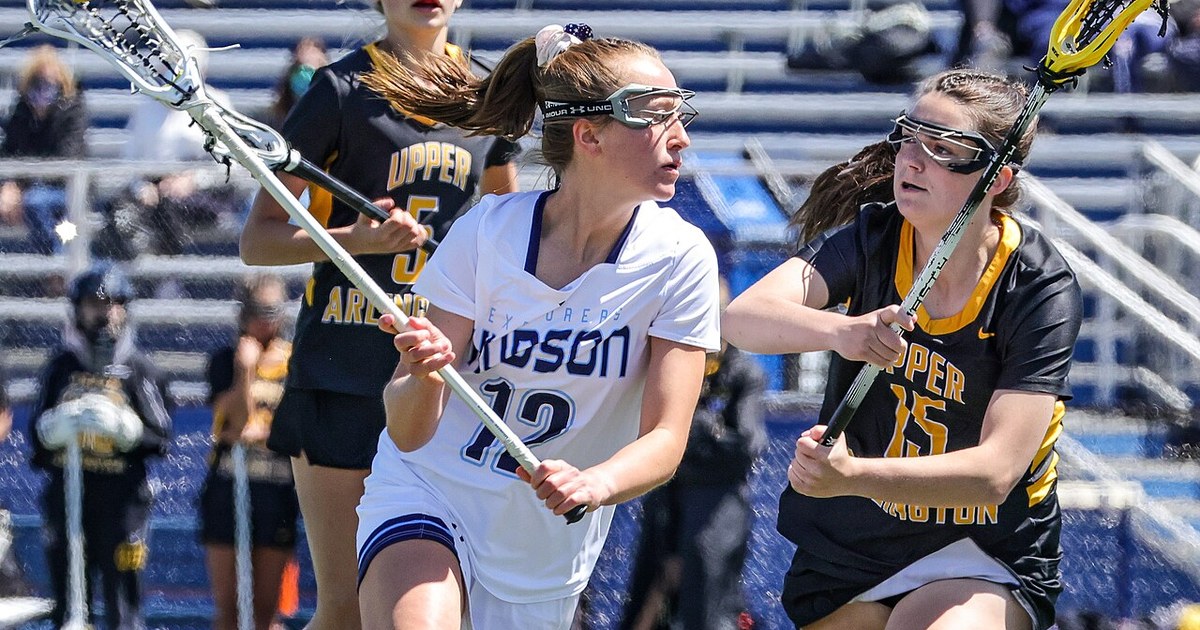
Photo: K.M. Klemencic / Wikimedia Commons
Middle School Is the Bridge Level
Grades 6 to 8 are where girls lacrosse stops being an introduction and becomes the real game in stages. The field gets full size, the checking ladder starts to climb, and players meet school teams, tryouts, and positions that stick. Families who understand which changes arrive at which level can read a season correctly: a sixth grader is not failing at the high school game, she is playing a deliberately different one.
Age grouping sits underneath everything. USA Lacrosse groups youth players by age with an August 31 cutoff, which is why a middle school roster mixes grades: a team's 12U and 14U divisions are age bands first and grade bands second. Your league's adoption of the age table decides who plays where.
What Changes, Level by Level
| Element | Younger youth game (10U and below) | Middle school game (12U and 14U) |
|---|
| Field | Small-sided, 60 to 70 by 35 to 45 yards | Full field, 110 to 140 by 60 to 70 yards, from 12U |
| Players | Small-sided formats with fewer players | 12 a side, including the goalie |
| Checking | No stick checking | Modified checking at 12U, transitional checking at 14U |
| Restart | Draw, often simplified | Full draw rules, with draw control tracked as a skill |
| Defense rules | Positioning taught, arc rules introduced gently | Three seconds and shooting space enforced in full |
| Team route | Rec programs and clinics | School teams, rec leagues, and club teams all run at once |
The Checking Ladder in Middle School
Middle school is where stick checking arrives, in two careful steps. At 12U, modified checking allows a check only when the ball carrier's whole stick is below her shoulder, with the checking motion directed down and away from the body. At 14U, transitional checking allows checks above the shoulder, but never across the body and never into the 12 inch sphere around the ball carrier's head. Body checking is never allowed at any level of the girls game.
The practical effect for parents: a seventh grader's legal check would be a foul for her fifth grade sister, and both are playing correctly. Coaches teach footwork first at both steps, because most middle school checking fouls come from reaching out of position, not from bad hands.
School Team, Rec League, or Club?
Three routes run side by side in middle school, and many players use two of them. A school team, where one exists, plays a spring season against nearby schools and is the most direct preview of high school lacrosse. Rec leagues stay local, welcome beginners in every grade, and cost the least commitment. Club teams organize by graduation year, travel to tournament weekends, and train outside the spring. None of the three is required for the others, and a player who starts in rec in seventh grade is not behind in any way that matters. Pick by schedule, budget, and how much lacrosse your daughter is asking for, not by fear.
A Readiness Checklist for High School
By the end of eighth grade, a player ready for high school lacrosse usually shows most of these:
- Catches and throws with both hands under light pressure, not only in line drills.
- Scoops through ground balls on the run instead of stopping over them.
- Knows her position's first job and can name the jobs of the spots next to hers.
- Plays legal defense with her feet: marking within a stick's length, no reaching across the body.
- Handles a full field game without fading in the second half.
- Owns her equipment routine: stick, goggles, mouthguard, and water, packed without reminders.
Missing one item is a summer project, not a verdict. High school coaches expect to teach; what they cannot teach in a tryout week is the habit of showing up prepared.
The Season Calendar a Middle School Family Actually Lives
A middle school year in lacrosse has a rhythm worth seeing whole. Fall is optional for most players: club tryouts, short fall ball leagues, and the first chance for a sixth grader to meet the bigger field in a low stakes setting. Winter is quiet in cold regions and skills based where indoor space exists. Spring is the season itself, school or rec, with practices several days a week in many programs and games stacked as weather allows. Summer belongs to club for the players who want it and to rest for everyone else.
Two planning truths follow. First, the spring of eighth grade is the busiest lacrosse season of the middle school years, because it doubles as the runway to high school, and families should protect it from avoidable overload. Second, a player who does nothing between seasons is not behind. The calendar has built in rest, and the players who arrive at high school healthy and still loving the game beat the ones who arrive decorated and tired.
Positions Start to Stick, and That Is Mostly Good
In the youth game, sensible coaches rotate everyone. In middle school, players begin living in a position group: attackers stay near the goal, defenders learn the arc as their home, and midfielders, the players who still do everything, discover whether their legs are built for the job. Specialization at this level should stay soft. A defender who never touches the attack end develops a one sided stick, and an attacker who never plays defense arrives at high school unable to ride or recover.
The healthy version looks like a home position plus a second one played in practices and lopsided games. Coaches who explain the plan out loud, you are a defender first and a midfielder when we need legs, produce players who accept the home role without feeling trapped by it. Parents can help by praising the home job in its own terms: the slide that arrived on time, the clear that started clean, rather than only counting goals.
What High School Coaches Watch at This Level
High school coaches who scout middle school games, formally or from the next field over, describe watching for things a stat sheet misses. Does she move without the ball, or stand and watch her own pass. Does she sprint back on defense with the same effort she sprints forward. Does she talk, calling cutters and ball position, or play silently. Does she recover from a mistake inside the same play. Stick skills matter, and at tryouts they are tested directly, but the habits above are what separate two players with equal sticks.
None of this requires club ball or private coaching to build. It requires a middle school coach who teaches the whole game and a player who practices being a complete midfielder or defender for two seasons. The checklist below gathers the readiness signs and the habits into one end of season review a family can run honestly at the kitchen table.
The first two weeks, planned
New middle school programs wobble most in the first two weeks, so plan them tighter than the rest of the season. Week one convention: three sessions of fundamentals only, wall ball or partner passing, ground balls, and the basic rules of the girls game taught on the field where they happen. Week two adds small sided games, two against one and three against two, so every player touches the ball constantly and nobody hides. Save full field scrimmaging until players can catch on the move; a scrimmage where the ball lives on the ground teaches only scrambling. Tell parents on day one what the season costs in time: practices per week, game days, and the one tournament weekend if there is one. Families forgive almost any schedule they hear early and almost none they hear late. Finish week two with a short parents meeting on the field: show the pocket test, show the eyewear, and show where the schedule lives online. Ten minutes of showing prevents a season of confused emails.
A Sample Week in the Middle School Season
Families new to the level ask what the commitment actually looks like, so here is one honest week from the middle of a school season, with a club practice folded in, because that overlap is where middle school calendars break.
Monday: school practice, 3:30 to 5:00, mostly team concepts and settled play, because Monday installs what the week will use. Homework starts after dinner, and the standing family rule is that the bag gets packed Monday night, not Tuesday morning. Tuesday: game day. The team dresses at school, plays at 4:15, and is home by 6:30 if the bus cooperates. This is the night homework was front loaded on Sunday, a trade every experienced family makes without being asked twice. Wednesday: school practice again, shorter and lighter, film and free positions and the fixes from Tuesday, then club practice from 7:00 to 8:30 for players who carry both. Wednesday is the load peak of the week, and it is the night to watch sleep and mood rather than add anything.
Thursday: second game day, same shape as Tuesday. Friday: no lacrosse at all by design, because a twelve year old who never gets an unstructured evening in season starts to dread the sport by May. Saturday: one club tournament day or a single club game, not both, and Sunday is kept for rest, family, and the schoolwork reset. Total organized lacrosse: about nine hours. Total crisis points: two, both on Wednesday, both solved by food, sleep, and a packed bag rather than by dropping a team. A family that can run this week calmly is ready for the level. A family drowning in it should cut the club layer first, keep the school team, and revisit in a year, because the school season is the one her friends and future coaches share.
One more small habit pays off all season: a Sunday ten minute reset. Bag emptied and repacked, mouthguard rinsed, schedule for the week read aloud once, and one question asked while it is still cheap to fix: what is going to be hard this week, and what do we do about it on Monday instead of Thursday?
The Tryout Week Survival Guide
School tryouts compress a season of judgment into three afternoons, so a short survival guide helps. Arrive with the boring things already solved: paperwork filed, physical on record, goggles and mouthguard in the bag, and cleats broken in the week before rather than the day of. Coaches notice the solved basics because they signal a family that will not generate April emergencies. On the field, the three behaviors that survive every cut conversation are hustle that shows on the way back, not just the way up, listening that shows in the very next rep after an instruction, and voice: a quiet seventh grader who calls one name clearly on one pass stands out in a gym full of silent players. Parents help most by shrinking their role that week to rides, food, water, and sleep, and by saving every evaluation for the drive home on the last day. A player who sleeps, eats, listens, and runs back hard has done everything tryouts can actually ask of her.
Frequently Asked Questions
What grades play middle school girls lacrosse?
Most programs serve grades 6 to 8, organized on the field by USA Lacrosse age divisions (12U and 14U) using the August 31 cutoff, so rosters blend grades by birthday.
Is checking allowed in middle school girls lacrosse?
Yes, in stages. Modified checking at 12U (stick below the shoulder, down and away) and transitional checking at 14U (above the shoulder allowed, never across the body or into the 12 inch sphere). Body checking is never allowed.
Does a player need club lacrosse to make a high school team?
No. School and rec players make high school rosters every year. Club adds extra games and coaching, but high school coaches select on skills, athleticism, and coachability shown at tryouts, not on which teams a player paid to join.
Can a player start lacrosse in eighth grade and still make a high school team?
Yes. Eighth grade beginners start every year and make junior varsity rosters, because high school coaches expect to teach and because athleticism and effort show immediately in tryouts. The new player should use the spring season and any summer clinic time to build the basics: catching and throwing with both hands, scooping on the run, and the defensive footwork from this page.
How many days a week does middle school lacrosse usually practice?
It varies by route, and the league or school sets the schedule. As a common pattern, school teams practice on most school days during the spring season, rec leagues practice once or twice a week with a weekend game, and club teams train one or two days a week around tournament weekends. Ask for the actual weekly schedule before registering, because the routes stack differently on a family calendar.