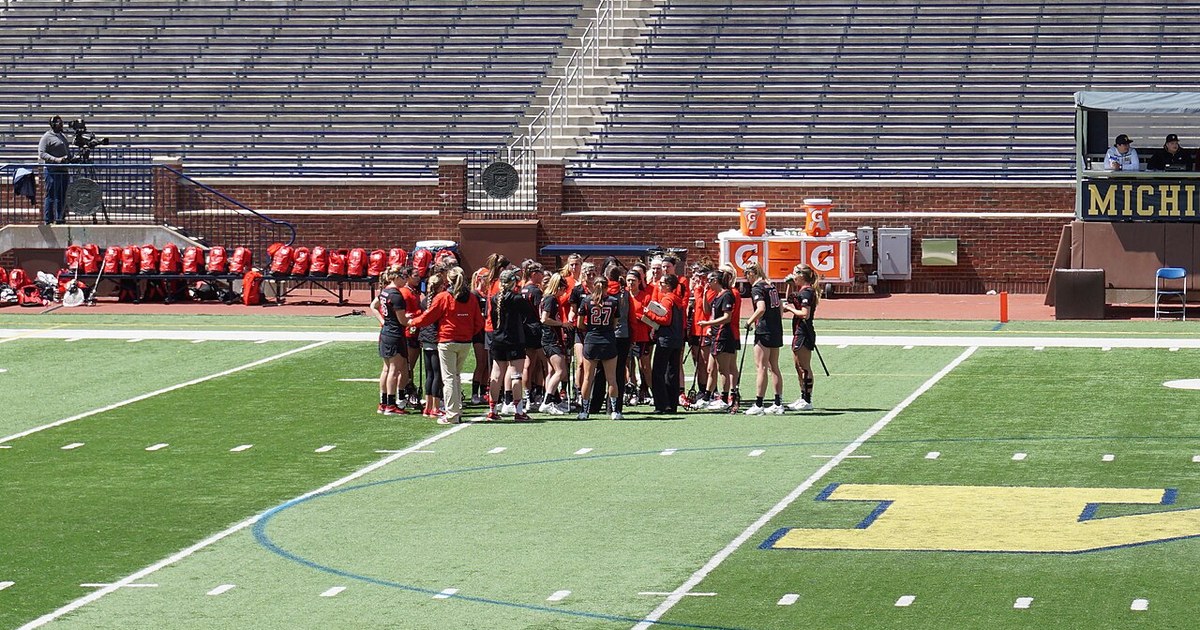
Motion Means Nobody Gets to Stand Still
A motion offense is a settled offense with no fixed play. All seven attackers stay balanced around the fan and the goal, the ball moves quickly around the outside, and every player without the ball is working: cutting, setting a pick, clearing out, or showing as an outlet. The classic teaching image is a wheel. The seven spots are the rim, the ball travels around it, and the defense is forced to keep turning its head until someone turns the wrong way.
Motion suits the girls game for a rules reason as well as a tactical one. A standing attacker is easy to mark, and at youth levels a closely guarded ball carrier works against the three seconds closely guarded count. Constant movement is not decoration. It is how the offense stays legal, balanced, and hard to read.
The Ball Carrier's Three Reads
Every time the ball arrives, the carrier makes the same decision in the same order:
| Situation | Ball carrier read | What it creates |
|---|
| Her defender is off balance or late | Challenge her: dodge hard to goal | A shot, or a slide that frees a teammate |
| Her defender is set and square | Back the ball out and move it on quickly | The wheel keeps turning; a better matchup appears elsewhere |
| A teammate's cut has beaten its defender | Feed the cut, on time and to the stick side away from pressure | A close shot before the defense can recover |
The discipline is in the second read. Young carriers hold the ball while they decide, and the whole wheel stops with them. In motion, a pass made early is almost never wrong, because the next player's reads start the moment the ball moves.
The Off-Ball Menu
The player who just passed the ball, and every attacker away from it, picks one job per possession:
- Cut. Run hard through the middle toward the goal, stick up as a target. If the feed does not come, keep running and clear out the far side.
- Pick. Set a legal screen, inside the defender's visual field with time and space for her to react, then roll or pop as the second option.
- Clear out. When a teammate dodges toward your space, vacate it and take your defender with you.
- Be an outlet. Stay one safe pass away from pressure so a trapped carrier always has an escape.
Two timing rules hold the menu together. Never cut at the same moment the carrier next to you is dodging, because her defender simply picks you up. And never send a long cross-wheel pass as a habit: it hangs in the air, crosses the whole defense, and is the pass motion offenses lose most often.
What Breaks a Motion Offense
Standing after passing is the first failure, and it is a habit, not a talent gap. The second is bunching: two attackers drifting into the same space let one defender guard both, and the wheel loses a spoke. The third is the hero dodge into a set defense. Charging into an established defender is a foul in the girls game, so the motion version of a power move is a fake, a shoulder turn, and a burst past a moving defender, never contact. When motion stalls, it is almost always one of these three, and each one is fixable in a week of practice.
A Starter Practice Setup
Teach the wheel before you teach any play.
Pass, cut, clear out (whole team, 12 minutes). Set seven cones on the seven spots around the fan. Players pass around the outside in order. After each pass, the passer cuts through the middle to the far side and fills the empty spot. Spacing: spots about 8 to 10 yards apart. Reps: three full rotations each direction, then add one passive defender in the middle. Coaching point: the cut starts as the pass leaves the stick, not after the catch.
Four on four motion (15 minutes). Live play inside the restraining line with one constraint: no shot until the ball has changed sides twice. The constraint forces the wheel to turn and teaches the back-out read better than any lecture.
Motion Against a Zone Defense
A zone changes the reads without changing the habits. Against a player to player defense, the wheel hunts a beaten defender. Against a zone, it hunts a seam: the soft border where two defenders each believe the other owns the cutter. The ball carrier's challenge read becomes an attack on the seam itself, a hard step between two zone defenders that forces one of them to commit and opens the pass behind her. Cutters time their runs for the moment the ball crosses the middle, because a zone turns its whole shape toward the ball and the far side cutter is open for exactly as long as the turn takes.
Patience is the discipline a zone tests. A motion offense that forces early shots into a set zone wastes the one advantage it owns, which is that the zone must keep moving as long as the ball does. Keep the wheel turning, attack seams rather than people, and the free positions and close shots arrive as the zone's rotations slow down late in possessions and late in games.
The Reset: Saving a Stalled Possession
Every motion possession eventually hits a moment where the dodge failed, the cutter is covered, and the ball carrier is guarded closely with the count running in the official's mind. The reset is the practiced answer. The carrier backs the ball out toward the top, the seven spots refill in order, and the wheel starts again with the defense now a step slower than it was. A reset is not a failed possession; it is the offense declining a bad shot in favor of a second turn of the wheel.
Young teams treat the reset as surrender and force the shot instead. Coached teams call it by name, often a single word from the sideline, and the whole unit relaxes into the shape again. The difference shows up in shot quality across a season more than in any single game.
Teaching Motion to Young Players
Motion is a lot of freedom to hand a twelve year old, so programs install it in layers. The first layer is one rule: after you pass, you move. Cut or clear out, but never stand and admire the pass. The second layer adds the outlet habit, always one safe pass away from pressure. The third layer, usually a season later, adds picks and the reads table from this page. Each layer is taught inside small sided games rather than walk throughs, because the decisions are the skill and decisions only appear at game speed.
Parents watching a young motion team should expect messiness. Two cutters will choose the same lane, a passer will clear out into the dodger's path, and the wheel will jam. That is the tuition. The teams that look polished at fourteen are the ones whose coaches let the wheel jam at twelve and fixed one habit at a time.
Motion and the Free Position Game
Motion offenses earn free positions as a byproduct, and smart teams plan for it. Defenders rotating late inside the arc commit the fouls the rules punish most: shooting space violations, three second violations, and checks across the body on a cutter. A team that moves the ball and its cutters patiently collects these the way a basketball team collects fouls on a tired defense. The free position from the 8 meter arc is among the best shots in the girls game, so an offense that produces two or three a half from pure movement is scoring without ever winning a dodge. The checklist below helps a player or coach audit a motion unit honestly: spacing, reads, off ball jobs, and reset discipline, all before the next practice.
Spacing numbers to coach by
Motion offense lives or dies on distances, so give players numbers instead of adjectives. The girls game fields twelve a side, four attack, three midfield, four defense, and a goalie, and the attacking seven who cross midfield must organize themselves around the 8 meter arc and the 12 meter fan. A workable convention: cutters time their cuts so two attackers are never inside the 8 meter arc at once unless one is leaving, and the ball side wing holds wide enough that her defender cannot cover both her and the crease. When spacing collapses, the fix is rarely a new play. It is one player sprinting back out to her spot so the next cut has somewhere to go. Coaches who freeze film usually find the same thing: the best motion teams are not faster, they are wider.
One Possession, Narrated Pass by Pass
Motion offense reads like chaos until one possession is slowed down, so here is a half field possession against a player to player defense, with the read named on every catch.
The ball starts high on the right with the first midfielder, whose defender plays her tight. Read one: no driving lane, so she moves the ball across the top to the second midfielder instead of forcing a dodge into help. On the catch, the second midfielder looks low first, because the cross field pass has pulled the defense toward the ball. Her crease attacker has sealed her defender behind her. Read two: the feed is on, but the slide defender is already stepping, so the crease player catches, feels the slide, and immediately moves the ball one more pass to the low left attacker, who has drifted to the back side pipe as the defense rotated. Read three: the low left attacker now has the choice the whole possession was built to create, a step down shot with her feet set, or a dodge against a defender closing out at speed. She takes the dodge, because a closing defender cannot change direction, draws the last slide, and the crease player, whose defender left to slide, is alone for the finish.
Count the decisions: three catches, three reads, zero standing still, and the shot came from the fourth option, not the first. That is the entire system in one rep, and it is why motion teams look better in the fourth quarter, when set plays have been scouted and legs are heavy but reads are reads.
The Three Mistakes That Look Like Motion but Are Not
Three habits wear the costume of motion offense while quietly killing it, and naming them saves weeks of practice. The first is passing and standing to admire it. The pass is only the trigger; the cutter who stops after passing becomes a defender's rest break, and the shape loses a spot until someone refills it. The second is cutting in straight lines at the ball carrier. Straight line cuts arrive with a defender attached and no angle to receive, while a curved cut that shows the stick early and bends away from help creates the passing lane the system promises. The third is the hero clear out, where four players vacate one side so a favorite can dodge into a double team that the defense happily sends. Real motion spreads defenders until helping hurts, then punishes the help. A coach who films one quarter and counts these three mistakes usually finds the offense's ceiling in a single viewing, because the fixes are mechanical, teachable, and entirely within the players' control.
Frequently Asked Questions
How is a motion offense different from a set play?
A set play is a scripted sequence run once for a specific shot. A motion offense is a set of habits that repeat on every possession: move the ball, cut after passing, clear space for the dodger, and take the read the defense gives you.
How many players are in a girls motion offense?
Seven attackers work inside the restraining line, the maximum the offside rule allows, balanced around the fan with players high, on the wings, and behind the goal.
Why does the ball have to move so quickly?
Because a still ball lets the defense rest, set its slides, and mark every cutter. Quick ball movement keeps defenders turning, and the openings in a motion offense come from defenders reacting late, not from attackers running faster.
Is there a time limit on a motion offense possession?
In the school game there is generally no shot clock, so a patient motion offense can keep the wheel turning until the defense breaks, limited by the closely guarded count on the carrier. The college game adds a shot clock, which compresses the same habits: the reads stay identical, but the reset has to happen faster and shots come earlier in the turn.
Can beginners run a motion offense?
Yes, in its layered form. Beginners start with one rule, move after every pass, and play small sided games where the habit forms. The full menu of cuts, picks, and reads is added across seasons. What beginners cannot run is a static offense, because standing still is both a tactical failure and, under the closely guarded count, a rules problem waiting to happen.