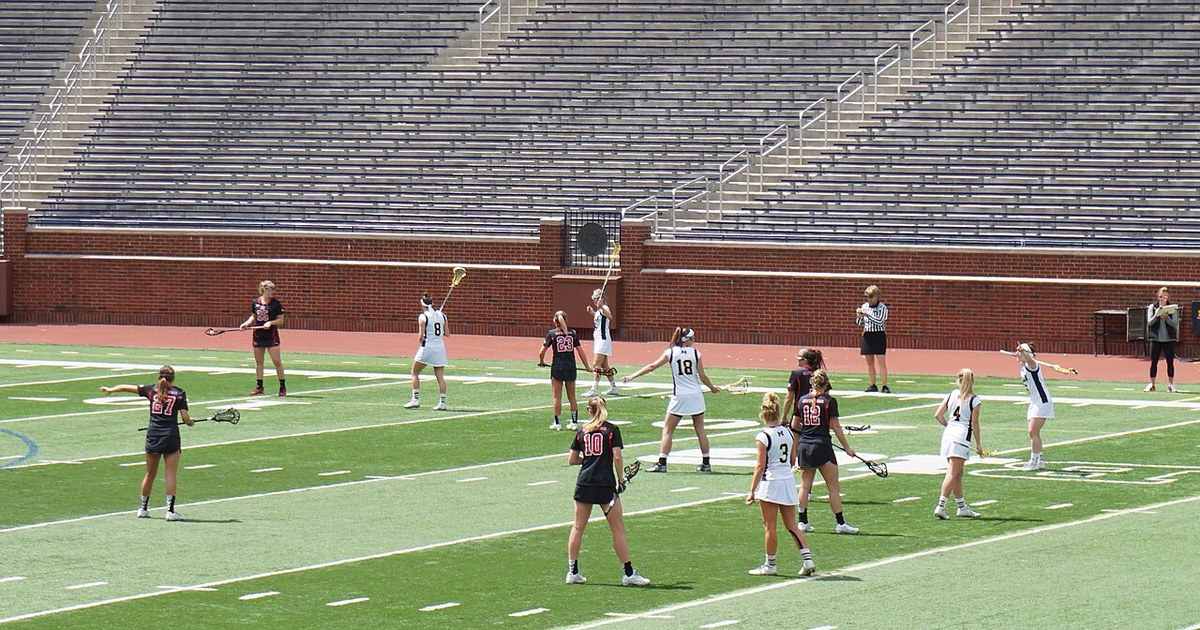
What NCAA Girls Lacrosse Means
When families say girls lacrosse NCAA, they mean college womens lacrosse played under the National Collegiate Athletic Association. It is the main college pathway in the United States, split into Division I, Division II, and Division III, plus lacrosse outside the NCAA in the NAIA and in college club leagues. The NCAA game is played under NCAA womens rules, which use a draw to start play, a shot clock, and free position shots, and it crowns a national champion in each division every spring.
The scale surprises many families. One current recruiting directory lists 132 Division I womens programs, and a college database counts more than 600 colleges with womens lacrosse across all levels. Division III is the largest division by program count, which is why most college players compete there rather than in the Division I games shown on television.
The Three Divisions
| Division | Character | Athletic scholarships |
|---|
| Division I | Highest level, biggest time commitment, national television coverage | Yes, partial awards are typical |
| Division II | Strong competition, often a balance of athletics and academics | Yes, partial awards are typical |
| Division III | Largest number of programs, academics first in structure | No athletic scholarships, but academic and need aid is common |
Division I is the level of North Carolina, Northwestern, Boston College, Syracuse, and Maryland, the programs that contest the televised championship. Division II programs are concentrated in the Northeast, Mid Atlantic, and Southeast and play a high level that overlaps with lower Division I on any given day. Division III includes many academically selective colleges, and for a strong student it can produce the best total aid package even without athletic money, because merit aid is generous.
Beyond the NCAA, the NAIA sponsors womens lacrosse at smaller colleges, and the Womens Collegiate Lacrosse Associates runs a large college club championship structure for schools without varsity teams. A player cut from varsity plans is not done with college lacrosse; club ball at a big university can be serious, organized, and competitive.
The NCAA Championship
Each division holds a single elimination championship tournament in May. The Division I tournament has been held since 1982, and Maryland is the most successful program in its history with fourteen titles, according to the tournament record. Conferences send automatic qualifiers and the selection committee adds at large teams, so the field mixes conference champions with the strongest remaining programs.
For a high school player, championship weekend is the best free education in what college lacrosse actually looks like: the pace of the draw, the speed of clears, and the size and speed of defenders are all a level beyond elite high school play. Watching it honestly helps a player set training goals.
Rules Differences a New Fan Notices
College womens lacrosse starts halves and restarts after goals with a draw, where two players contest the ball between their sticks at center. A shot clock forces the offense to shoot within a set time, which keeps the college game moving and rewards efficient offense. Free position shots from the arc punish defensive fouls in the scoring area, and the three seconds rule stops a defender from camping in front of the goal without marking an attacker.
Games are played in quarters at the college level, rosters carry specialists including draw specialists, and substitution is free and constant, so the college game uses more players per game than a typical high school game.
Scholarships and Recruiting in Brief
Womens lacrosse is an equivalency sport, which means a coaching staff divides its scholarship pool into partial awards across the roster rather than giving every player a full ride. Full athletic scholarships are rare. Families should compare the total cost after all aid, athletic, academic, and need based, across divisions.
Recruiting contact for Division I cannot begin directly between coaches and players until September 1 of junior year, though players can send film and emails earlier and attend camps where coaches instruct. Eligibility runs through the NCAA Eligibility Center for Division I and II, with core course and grade requirements that a school counselor should check early, not in senior spring.
How Hard Is the Jump
The honest summary: the college game is faster in every direction. The ball moves quicker, shots come from better shooters, and every defender can run. The players who adjust fastest are not always the highest scorers in high school; they are the ones with both hands, clean ground balls, and the fitness to repeat sprints. A high school junior who wants this level should train those traits now, choose a target list across divisions, and treat grades as a recruiting asset, because a coach can recruit a strong student with far less risk.
A College Game Day, Watched Properly
A high school player learns more from one college game watched with a notebook than from a season of highlight clips. Watch the draw unit first: college draws are a specialist contest with its own personnel, and the circle play is faster and more physical within the rules than anything in the school game. Watch the clear next, because college teams ride hard and a failed clear is the most common way a good team bleeds goals. Then watch the benches. The number of players rotating, especially in the midfield, explains the pace: college coaches substitute lines of midfielders to keep sprint speed high for four quarters.
Finally, watch what does not happen. College defenses rarely give up the middle cheaply, college carriers rarely hold the ball long enough to be counted on, and college goalies clear the ball so quickly that the outlet pass looks like part of the save. Those absences are the standard a recruit is really being measured against.
Division III, Honestly Appraised
Division III is sometimes described to families as a consolation level, which misreads the largest division in the sport. The top of Division III plays a fast, skilled game that beats the bottom of Division I on plenty of spring afternoons, and its rosters are full of players who chose academic fit, playing time, or a saner calendar over a logo. What Division III does not offer is athletic scholarship money, and what it often offers instead, merit and need aid at academically strong colleges, can exceed a partial athletic award elsewhere.
The recruiting calendar also runs differently. Division III coaches can communicate on a more open timeline than the September 1 junior year line that governs Division I contact, which means a Division III hopeful can build real relationships with coaches earlier and with less guesswork. For many players, that honesty arrives as a relief: the level finds them through conversation rather than through a single evaluation weekend.
The Eligibility Center in Plain Language
Division I and II players register with the NCAA Eligibility Center, which certifies two things: that the player completed the required core courses in high school, and that her grades in those courses meet the standard. The practical advice is boring and decisive. Tell the school counselor in freshman or sophomore year that an NCAA sport is a goal, so the course plan is built from approved core classes from the start. Check the transcript against the requirement list every year, not once at the end. Players lose eligibility far more often to a missing core course discovered in senior spring than to anything that happens on a field.
Division III has no Eligibility Center certification; its schools set their own admission standards, which is one more reason grades function as recruiting currency there. The checklist below turns the college path into a family review: divisions understood, aid compared on total cost, eligibility protected early, and a playing option kept open at every level.
Reading a college roster like a recruit
A roster page tells a recruit more than a brochure does. Count the players by class: a team graduating eight seniors has real openings, while a team of mostly sophomores will recruit your position lightly whatever the coach says in an email. Count the goalies separately, because programs carry few and recruit the position earliest. Note where players come from: some programs recruit nationally, others draw almost entirely from two or three states, and both patterns are stable year to year. Then check the schedule strength the program plays, since development follows opposition. None of these numbers appears in a ranking table; they are a convention for reading what a program actually is, and thirty minutes with three roster pages will sort a long list faster than any showcase. Families who do this homework write shorter, better emails, because every claim in the email matches something the program demonstrably needs.
Worked Example: Comparing Two Realistic College Options
Recruiting advice stays vague until real numbers sit side by side, so here is the comparison a family actually faces, with the names removed and the math left in.
Option A is a Division II program offering an athletic scholarship of 9,000 dollars a year against a total cost of attendance of 41,000 dollars. The roster lists 34 players, the program plays about 17 games a year, and the school is a four hour drive from home. Option B is a Division III program with no athletic money, offering a merit award of 14,000 dollars a year against a total cost of 52,000 dollars, with a roster of 27 and a campus ninety minutes away. The headline says Division II wins, because it has the athletic scholarship. The four year math says otherwise: option A leaves 32,000 dollars a year to cover, or 128,000 over a degree, while option B leaves 38,000 a year, or 152,000, so A still wins on cost, but by 24,000 dollars over four years, not by the 36,000 the scholarship headline suggests.
Then the playing math. On a 34 player roster with 12 starters and a short bench rotation, a mid ranked recruit may see spot minutes as a sophomore. On a 27 player roster, the same player plausibly dresses and rotates as a first year. Families should ask both staffs the same three questions: how many players at my position graduate before I arrive, how many are you recruiting at my position in my class, and what did your last three recruits at my position play as sophomores. The answers, written down, are worth more than any ranking, because they convert a dream into a depth chart.
The Transfer Portal, in Plain Language
One modern part of college lacrosse confuses families more than any rule on the field: the transfer portal. In plain terms, it is a database where a player who wants to change schools registers her name, after which other college coaches may contact her. Entering it is not quitting a team in anger; it is a formal step with deadlines, paperwork through the school's compliance office, and real consequences, because a player who enters may find her roster spot and scholarship situation changed at her current school. Players transfer for honest reasons: a coaching change, a program cut, a major their school does not offer, or a depth chart that leaves them watching for four years. The lacrosse lesson for a high school recruit is indirect but valuable. Ask a college coach how many transfers the program has taken and how many it has lost in the last three years. A program that keeps its players is telling you something good about itself, in numbers, before you sign anything.
Frequently Asked Questions
How many NCAA womens lacrosse programs are there?
More than 500 across the three divisions, with Division III the largest group. One current directory lists 132 Division I programs alone, and college databases count more than 600 womens programs when NAIA and other levels are included.
Does girls lacrosse use the same rules in the NCAA as in high school?
The base game is the same, but the NCAA adds a shot clock, uses its own rule book and championship structure, and plays quarters. High school follows NFHS rules, and youth follows USA Lacrosse rules, so details change at each step up.
Can a player walk on to an NCAA lacrosse team?
Some programs hold walk on opportunities, more often in Division II, Division III, and club lacrosse than in top Division I programs. Ask the coaching staff directly before enrolling, and keep club lacrosse in mind as a strong playing option at many universities.
When is the NCAA women's lacrosse season?
Lacrosse is a spring sport in the NCAA. Regular season play runs through the spring, conference tournaments follow, and the national championship tournaments in all three divisions conclude in May. Fall ball exists as a short practice and scrimmage season, but the championship season is spring.
Is there a shot clock in NCAA women's lacrosse?
Yes. The college game uses a shot clock, which is one of the clearest differences from the high school game under NFHS rules. The clock forces offenses to organize quickly, rewards draw control and efficient clears, and is a major reason the college game looks faster even before the athletes' speed is counted.