Seven Attackers, One Shape
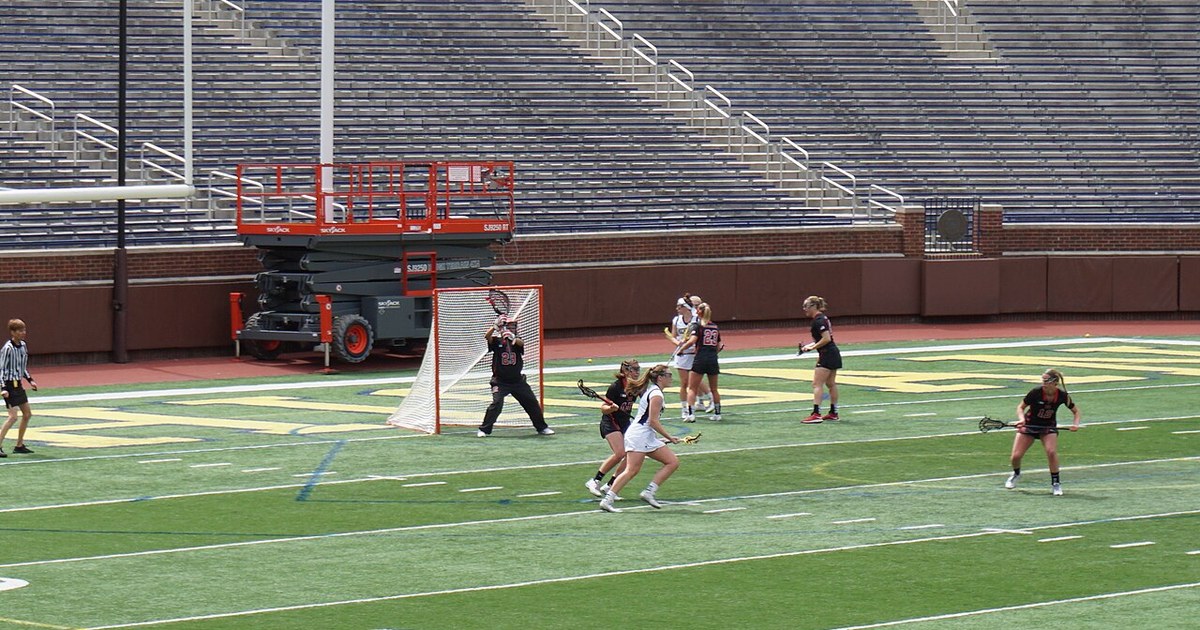
Settled girls offense is played seven against seven inside the restraining line, with the goalie making eight defenders. The restraining line sets the ceiling: at most seven attackers may cross into the scoring end, so every girls offense is built from the same seven spots. Coaches name the spots differently, homes, wings, elbows, and X, but the jobs are stable across programs. If you learn the seven jobs, you can walk into any team's huddle and understand the whiteboard.
This page teaches the unit itself: the spots, the sets they form, and the flow of a possession. Named plays and starter patterns live in the girls lacrosse plays guide, and the continuous motion system lives in the motion offense guide.
The Seven Spots and Their Jobs
| Spot | Where she plays | Her first job |
|---|
| X (behind the goal) | Directly behind the cage | Quarterback the set: feed cutters, dodge around the crease when her defender turns |
| Two low wings | Either side of the goal, near the 8 meter arc | Finish feeds, set picks for cutters, clear out when X dodges their side |
| Two elbows | Top corners of the 8 meter arc | Dodge downhill to goal, swing the ball across the top |
| Two high middies | Above the 12 meter fan | Start dodges from the top, protect against the fast break the other way |
Balance is the point. With two behind and low, two at the elbows, and two high, the defense must guard the front, both sides, and behind the goal at once, and no single slide covers two spots.
The Common Sets
| Set | Shape | Strength | Watch out for |
|---|
| 3-2-2 | Three high, two at the elbows and wings, two low and behind | The standard teaching set; every spot is easy to learn and replace | Can go static if the high three only pass around the outside |
| 2-4-1 | Two high, four across the middle, one at X | Packs cutters near the goal for feed-heavy teams | Crowds the middle; cutters must clear out on time or they block each other |
| Stacked | A vertical line of attackers on one side, cutting in sequence | Confuses switching defenses; one feeder behind the goal serves the whole stack | The far side empties, so a turnover becomes an easy clear for the defense |
Sets are starting shapes, not scripts. Good offenses begin in a set, then flow into cuts, picks, and dodges, and reset to the shape whenever a possession stalls.
How a Possession Flows
Most goals are not scored from the set at all. The first look is always the fast break: a draw win, a save, or a turnover sends attackers running at a defense that has not organized, and the offense attacks before the seventh defender arrives. If the break is stopped, the attackers pull the ball out, take their seven spots, and the settled offense begins. From there the possession is a loop: swing the ball, test a dodge, feed a cutter, and reset. The loop ends with a shot, a foul that gives a free position on the 8 meter arc, or a turnover and a ride to win the ball back.
Two girls rules shape every loop. The defense cannot camp in the arc (the three second rule) and cannot stand in the shooting lane unattached (shooting space), so a patient offense that keeps moving the ball and the cutters will eventually be handed a free position even when no dodge beats anyone. At youth levels, the three seconds closely guarded count on the ball carrier adds the opposite pressure: hold the ball too long under a legal guard and the whistle goes the other way.
The Ride: The Offense Nobody Draws on the Whiteboard
When a possession ends in a save or a turnover, the seven attackers become the first line of defense, and that job has a name: the ride. The nearest attacker pressures the ball carrier immediately, the others mark the clearing outlets and sprint back toward the restraining line in order, and the unit tries to win the ball back before the clear crosses midfield. A good ride turns one possession into two, and it is built from the same seven spots: players who know where they are in the shape can find their riding lanes without looking around.
Riding is also where the player advantage swings back. A team that jogs after a missed shot gives the clear a free run and defends the fast break it allowed. A team that rides with structure defends from the front, and its settled defense starts each possession already organized. Coaches grade rides the way they grade sets, because over a season the ride decides field position as surely as the draw does.
Free Positions: The Offense Within the Offense
A free position on the 8 meter arc is a designed scoring chance handed to the offense by a defensive foul, and prepared teams treat it as a play, not a pause. The shooter reads the goalie and the nearest defenders, the attackers on the arc edges position for a rebound or a quick pass off the whistle, and everyone knows the second option if the direct shot is taken away. Because shooting space and three second fouls are exactly the fouls a patient offense provokes, the free position unit and the settled offense are the same skill seen from two angles.
The drill planner below builds practice from the established attack dodging bank on this site: split dodges at a cone, question mark moves from X, face dodges against a shadow, and feed or finish reads. Those four drills train the exact moments a settled possession is decided, the dodge from the elbow, the run from X, and the read when the slide comes.
Reading a Zone From the Seven Spots
Against a zone, the seven spots stop being addresses and become pressure points. The offense overloads one side by shifting a high middie across, attacks the seams between zone defenders with cutters timed to the ball swing, and uses the player at X more than ever, because a zone turns toward the ball and X sees the whole shape from behind. The shot a zone concedes is usually not the first one offered; it is the one after the second swing, when the far side defender has taken two steps toward the ball and left her slice open.
Patience is a skill here, and it has a limit: the closely guarded count still runs on the carrier, so the ball must keep moving even when no shot is taken. A zone possession is a conversation the offense wins by asking questions faster than the defense can answer them.
A three step dodge progression for attackers
Settled offense improves fastest when dodging skill is built in layers. Step one is the split dodge at a cone: sell the first move with the shoulders, change hands in one motion, and explode out of the plant. Step two adds a shadow defender who mirrors without checking, and the attacker learns the face dodge, bringing the stick across the face rather than around the head. Step three is the read: from behind the goal at X, the dodger watches for the slide; if it comes, she feeds the cutter, and if it holds, she turns at goal line extended and finishes. This progression is a coaching convention, not a rule, and it works because each layer adds exactly one decision. Attackers who skip to layer three early develop the habit of dodging into help. Attackers who own the first two layers find that the third mostly reads itself, and the whole offense speeds up because the first dodge of a possession finally threatens the goal.
A Two Week Practice Plan That Installs the Seven Spots
Coaches inherit players who know their position name but not the shape, so here is a four practice install, two sessions a week, that puts the seven spot offense in without a single lecture longer than five minutes.
Practice one is geography. Cones mark the seven spots, players walk the shape at a jog, and every pass must travel to a named spot, called out loud by the receiver before the catch. The only rule added on day one is the refill: when a player cuts or clears out, the nearest teammate sprints to the empty spot, so the shape heals itself. Practice two adds the crease exchange. The two low players trade places behind and in front of the goal on every third pass, while the five high players keep the shape, and the defense is still passive, because the lesson is timing, not beating anyone. By the end of practice two, most groups can run two full minutes of passes with the shape intact.
Practice three adds one live defender on the ball and one on the crease, and introduces the feed decision: the crease player is a target only when her defender has turned her head. Practice four removes the cones, adds a full defense at half speed, and ends with ten minutes at game speed, where the coach freezes play only for shape errors, never for missed shots. The install works because each practice adds exactly one idea and because the refill rule, taught on the first day, quietly solves the most common youth offense failure, which is three players drifting to the same third of the field while the shape collapses behind them.
Reading the Defense's Shape in the First Two Possessions
An offense reveals itself slowly, but a defense announces its plan almost immediately, and attackers who read the announcement spend the game attacking a known system instead of a mystery. In the first possession, note where the help comes from on a hard dodge. If the slide arrives from the crease every time, the back side low spot will be open all day, and the offense should run its dodges to invite that slide and feed the vacated space. If the defense switches screens willingly, the slip, where the screener leaves early before contact, becomes the best play on the field. In the second possession, test the defense's patience with one long, patient rotation of passes. A defense that starts jumping passing lanes is a defense that will foul inside the fan by the second quarter, and the free position game becomes the plan. Two possessions, two questions, and the offense has a scouting report it wrote itself, at game speed, for free.
Frequently Asked Questions
How many players play offense in girls lacrosse?
Seven attackers at a time inside the restraining line, plus midfielders who join from the high spots. The offside rule caps the scoring end at seven attackers and eight defenders including the goalie.
What is the most common girls lacrosse offensive set?
The 3-2-2: three players high, two in the middle band, and two low or behind the goal. It is the easiest set to teach because every spot has a clear replacement when a player cuts.
Where does the offense usually run from?
Many teams run settled offense through the player at X, behind the goal. From there she sees every cutter in front of her, can feed either side, and can dodge around the crease herself if her defender watches the ball.
What happens to the offense when a defender gets a yellow card?
The carded player's team plays short for the penalty period, and the offense gains a player advantage. Prepared teams have a set shape for the advantage: an extra attacker overloads one side, the ball moves quickly to force the shorthanded defense to rotate, and the shot comes from the rotation, not from forcing a dodge against a set defender.
Why does the offense pull the ball out after a stopped fast break?
Because numbers decide shots. A fast break attacks a defense that is short or disorganized; once the defense recovers to seven plus the goalie, charging in alone trades a good future chance for a poor present one. Pulling out to the seven spots restarts the possession with balance, all options open, and the defense forced to guard the full shape.