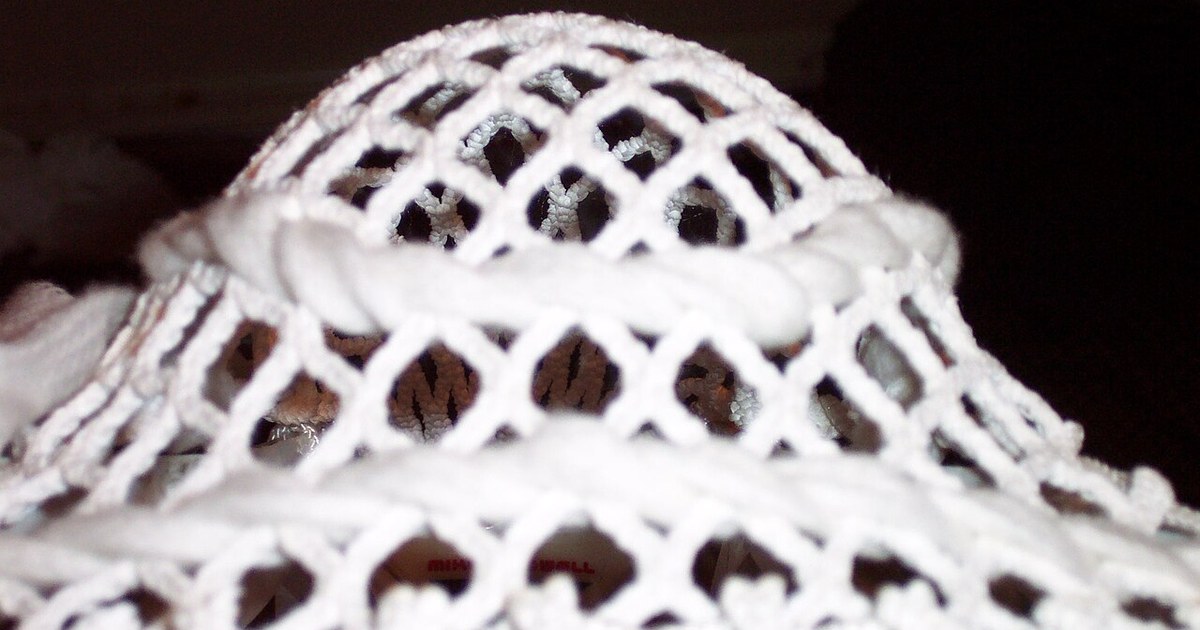
Mesh Is the Newcomer in the Girls Game
For most of its history, the girls and womens game did not allow mesh at all. Pockets were strung traditionally, with leather or synthetic runners and woven cross-lacing, because the rules said so. Nylon mesh became legal in womens sticks only in 2018. That late arrival explains everything about girls mesh today: it exists, it is popular, and it is regulated more tightly than the mesh in a boys stick, because it was admitted into a game whose pocket rules were written around string.
When people say girls lacrosse mesh, they usually mean one of two things: a full mesh pocket, strung much like a mens pocket but shallower, or a mesh runner, a strip of mesh running down the center of the pocket with traditional stringing on either side. Both are legal when they meet the pocket rules. Both are judged by the same depth test as every girls pocket.
Traditional and Mesh, Side by Side
| Feature | Traditional pocket | Mesh pocket |
|---|
| Main structure | Two to five runners running the full length of the head | A woven mesh panel attached through the sidewall holes |
| Cross structure | Eight to twelve stitches of cross-lacing between the runners | The mesh weave itself |
| Shooting strings | At most two, attached directly to the sidewalls | At most two, attached directly to the sidewalls |
| Weather behavior | Leather runners stretch and shrink with wet and dry | Mesh holds its shape in the rain |
| Break-in | Slow, and the pocket changes as it settles | Fast, and more consistent from stick to stick |
| Feel | Soft hold, very tunable by a skilled stringer | Defined channel, repeatable release |
Neither column is the correct choice. Traditional stringing remains popular with players who like its soft hold and with stringers who can tune it. Mesh won converts with consistency: two sticks strung with the same mesh pattern play alike, which traditional pockets rarely do.
The Rules That Govern Girls Mesh
The pocket rules do not care which material you chose. They care about geometry.
- Depth: with the ball pressed into the pocket and the stick held level, the top of the ball must stay visible above the top edge of the sidewall, checked from the front and the back. This is the womens test, and it is stricter than the mens bottom-edge test.
- Gaps: no hole or gap in the stringing may be larger than 1.5 inches. Officials look for this in a stick check, and stretched mesh fails here before it fails on depth.
- Attachment: the pocket must attach to the head through the stringing holes in the sidewall, scoop, and ball stop area. Incoming 2027 standards tighten this further, requiring mesh to sit tight to the side rail with a gap no greater than the width of two nylons.
- Shooting strings: no more than two, and they must attach directly to the sidewalls. Extra decorative strings that are not part of the pocket structure are not allowed under the incoming standard.
- Runners: any lengthwise strand that behaves like a runner, including a fused or coiled mesh strand standing proud of the surrounding mesh, is judged as a runner. Runners must run continuously from the ball stop to the scoop and measure 0.3 to 1.0 cm across.
Telling a Legal Mesh Pocket From an Illegal One
- Press a ball into the pocket and hold the stick level at eye height. Top of the ball visible above the top edge of the sidewall? Check the back of the head as well as the front.
- Run a finger across the mesh. Any gap you can push two fingers through side by side is approaching the 1.5 inch limit and will stretch past it.
- Follow the mesh edge to the sidewall. It should be tied through the holes, tight to the rail, not floating on a loose sidewall string.
- Count the shooting strings: two at most, both tied to the sidewalls.
- Retest after the first weeks of play and after rain. Mesh settles, and a pocket that passed in the shop can bag out by the third game.
Keeping a Legal Mesh Pocket Legal
Mesh earned its reputation for consistency honestly, but consistent does not mean permanent. A mesh pocket changes slowly in two directions that both point toward a failed stick check. The weave stretches with use, which deepens the pocket against the depth test. The diamonds near the sidewalls open with wear, which grows the gaps toward the 1.5 inch limit. Heat makes both worse: a stick left in a hot car trunk between tournament games comes out measurably softer than it went in.
The care routine is unglamorous and short. Store the stick indoors at room temperature, never in the trunk. After a wet game, let the pocket dry at its natural shape with a ball resting in it, rather than pulling the mesh tight while it dries. Run the five checks from the section above once a month in season, and before any tournament where officials check sticks as a matter of routine. A pocket drifting toward the line can often be corrected by a stringer with a sidewall adjustment, which is a small job in April and a failed check in May if it is left alone.
First Pocket or Later Switch
Families meet mesh at two different moments, and the right answer differs. For a first stick, the argument for mesh is the learning curve: a beginner cannot yet feel the difference between stringing types, and a pocket that plays the same every day lets her blame her hands, correctly, while they learn. Traditional stringing on a first stick adds a variable she cannot read yet.
For an experienced player switching from traditional, the calculus flips. She has a release she trusts, built on the soft hold of runners and cross lace, and mesh will change that release for a few weeks. Switch in the off season, never mid season, and keep the old stick strung and legal as the backup while the new pocket earns trust. Players who switch for weather reasons, tired of a traditional pocket changing in the rain, usually stay with mesh. Players who switch out of curiosity alone often switch back, which is also a fine outcome; the material serves the player, not the other way around.
What Stringers Wish Players Knew
Stringers who work on girls sticks repeat a few requests often enough that they belong in print. Bring the whole stick, not just the head, because pocket depth is judged on the complete stick and shaft length changes how a pocket is tensioned. Say how the current pocket fails in plain words, too deep, throws high, catches hard, rather than asking for a named pattern copied from a video. And give a new pocket its break in games before judging it: mesh settles over the first weeks, and a pocket restrung on Monday is not finished becoming itself until it has been played.
The checklist below folds the legality checks and the care routine into one monthly habit, which is all that keeping a mesh pocket legal really requires.
Pocket rules change as players age up
Mesh legality is judged against the same pocket tests at every level, but the allowances underneath them shift with age. At 10U, a modified pocket is permitted, and the standard is that no more than half the ball may sit below the sidewall. From 12U up, the full test applies: with the stick held flat, the top of the ball must be visible above the sidewall, and when the stick is turned upside down the ball must fall out freely. A mesh pocket strung to the 10U allowance will fail the older test, which surprises families every spring. When a player ages up, restring or replace the pocket before the first practice rather than after a failed check. Build the habit of running both halves of the test at home: flat hold first, then the inversion. Ten seconds with a ball in the pocket tells you more than any product description.
The Monthly Pocket Check, Worked on a Real Stick
Habits stick when they have a worked example, so here is one full monthly check, with the numbers a player would actually write down, on a mesh pocket that has been played for five weeks.
Minute one, the flat hold. The stick is held level, ball resting in the pocket. The top of the ball sits a finger width above the sidewall at the widest point of the head. Recorded: pass, with margin. Last month the margin was two finger widths, so the pocket has settled deeper by roughly one finger width in five weeks, which is the normal break in curve for new mesh, and worth noting rather than fearing. Minute two, the inversion. The stick turns over slowly; the ball drops out cleanly on the first gentle shake. Recorded: pass. A ball that needs a hard shake at month two is a ball that will fail outright at a tournament stick check in month four, so the shake quality goes in the log too, not just the result.
Minute three, the gap gauge. A folded index card, which is close to the width that matters, is worked along both sidewalls. The largest gap, near the throat, admits the card with light pressure but not a second card beside it. Recorded: under the 1.5 inch limit with room, exact spot noted so next month compares the same place. Minute four, the shooting strings: two, both attached at the sidewalls, neither so tight it has begun to saw into the mesh. Total elapsed time, under five minutes, and the log now holds three months of comparable numbers. When a stringer later asks how the pocket has changed, this player does not shrug. She hands over dates and measurements, and the adjustment takes ten minutes instead of a restringing guess.
When the Pocket Fails a Check: The Fifteen Minute Sideline Fix
A failed stick check at a tournament feels like a disaster and is usually a fifteen minute repair, provided the player knows which adjustment answers which failure. If the ball sits too deep, the fix lives at the bottom string and the lower sidewall knots: tightening the bottom string lifts the pocket floor, and one knot pulled snug on each sidewall raises the ball without changing the pocket's shape up top. If the ball will not fall out on the inversion test, the pocket is holding too much at the throat, and loosening the throat lacing by one loop usually frees it. If a sidewall gap has stretched past the limit, that section needs a stringer's hands, not a sideline tug, and the honest move is the backup stick. Every tournament player should carry one, strung conservatively, checked at home the night before, and boring by design. The backup stick is not a lesser stick. It is the reason a failed check becomes a story instead of a forfeited game.
Frequently Asked Questions
Is mesh legal in girls lacrosse?
Yes, since 2018. A girls stick may carry a full mesh pocket or a mesh runner, as long as the pocket passes the womens depth test, keeps every gap at or under 1.5 inches, and uses no more than two shooting strings attached to the sidewalls.
Is mesh or traditional stringing better for a girls stick?
Neither is better in the abstract. Mesh is more consistent and shrugs off weather; traditional stringing offers a softer, more tunable hold. Players who restring often and like to tinker lean traditional; players who want the same pocket every day lean mesh.
Does a mesh pocket make a girls stick illegal if it stretches?
It can. Stretched mesh deepens the pocket and widens gaps, and both are checked. The pocket that matters is the one in the stick on game day, not the one that left the stringer's table.
Can young players use mesh pockets?
Yes, with the youth pocket rule applied. At 10U, girls may use a modified pocket in which no more than half the ball sits below the sidewall, and mesh is strung to that standard the same way traditional stringing is. At 12U and above, the standard test applies: top of the ball visible above the sidewall, and the ball falling freely when the stick is turned over.
How long does a mesh pocket last?
There is no fixed lifespan, because the pocket ends by condition rather than by date. Judge it by the checks on this page: when the depth test starts failing between adjustments, or the gaps near the sidewalls approach the 1.5 inch limit and stay there after a stringer has tightened the pocket, the mesh is done. A pocket checked monthly rarely surprises its owner at a stick check.