Girls Lacrosse Sticks Explained: Pocket Rules, Types, and How to Choose
By the OYLAX Lacrosse Guide editorial team
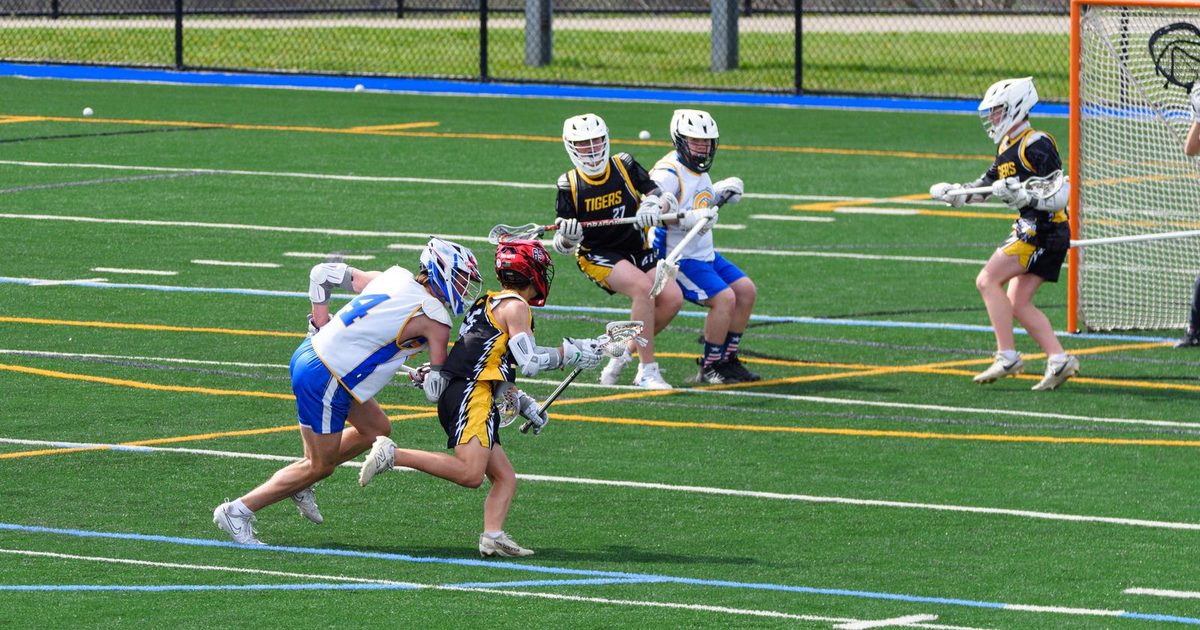
Photo: Jay Brand / Pexels
Why Girls Sticks Are Their Own Category
A girls lacrosse stick is not a smaller version of a boys stick. It is built for a different set of rules. The girls game limits how deep the pocket can be, limits body contact, and rewards quick passing and precise catching. A stick designed for those rules will help a player learn correct technique from the first practice.
The differences are written into the rulebook, not into marketing. A girls field stick measures 35.5 to 43.25 inches overall. The head measures 7 to 9 inches wide. The pocket must stay shallow enough that the top of the ball shows above the sidewall. And USA Lacrosse maintains a list of legal womens sticks that governs what may be used as players reach the high school level. This guide walks through each rule, the two tests officials use to enforce the pocket rule, and a buying path by age, with the data credited to USA Lacrosse throughout.
The Pocket Rule, Stated Precisely
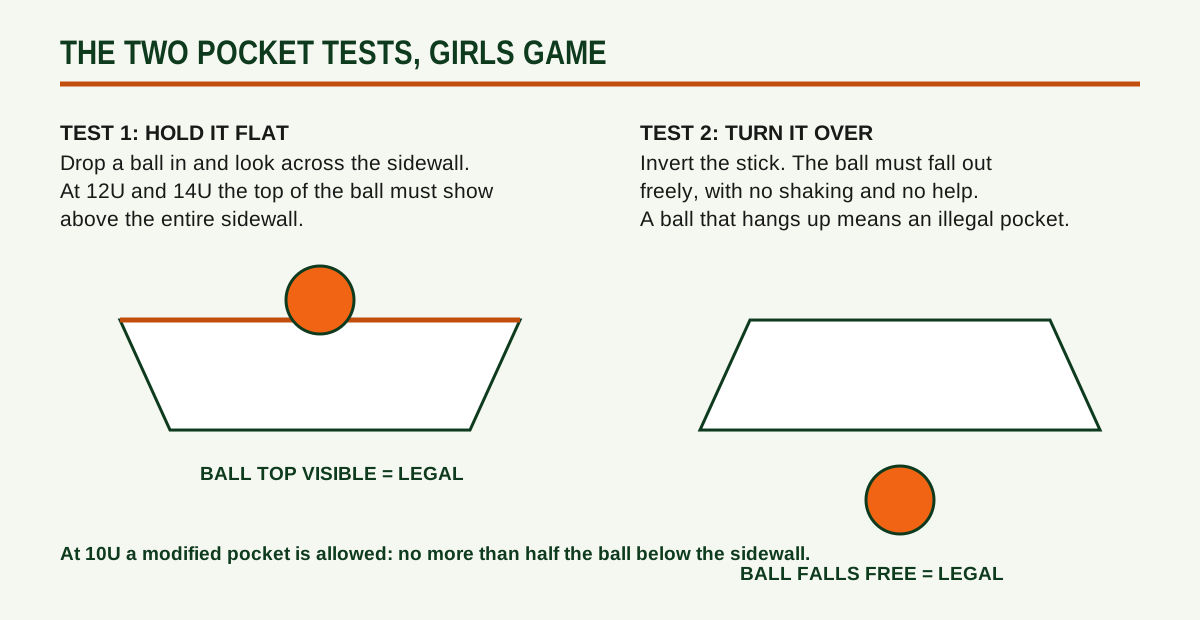
Hold the stick flat, parallel to the ground, and drop a ball into the pocket. Look at the stick from the side, at eye level. At 12U and 14U, and at every level above, the top of the ball must be visible above the entire sidewall of the head. If any part of the sidewall hides the top of the ball, the pocket is too deep and the stick is illegal.
Then turn the stick upside down. The ball must fall out freely, on its own, with no shaking, no tapping, and no help from a finger. A pocket that passes the flat test but traps the ball upside down still fails. Officials may check any stick on the field, and players get pockets checked before games, after goals, and whenever an official suspects a problem, so legality is not a preseason event. It is a season long condition, because strings stretch.
At 10U the rule relaxes into the modified pocket. A 10U player may use a smaller stick with a pocket deepened on purpose to make catching learnable, with one hard limit: no more than half the ball may sit below the sidewall. Below 10U, smaller sticks are allowed and programs prioritize a stick a small player can actually handle.
Diagram of the two girls pocket depth tests: the ball visible above the sidewall held flat, and the ball falling freely when inverted
Why the rule exists
The shallow pocket is the girls game in miniature. With the ball riding high, it leaves the stick quickly, checks dislodge it honestly, and the game rewards the player who moves the ball rather than the player who hides it. A deep pocket would turn girls lacrosse into a carrying contest the rulebook deliberately refuses to host. When a young player struggles to keep the ball in a legal pocket, the answer is cradle technique and softer hands on the catch, not a deeper bag.
Find the Girls Numbers for Your Player
Interactive tool
Stick Finder: Legal Length by Game, Age, and Position
Pick your game, age group, and position. Lengths come from the USA Lacrosse equipment guide and youth rules compiled for this site. Local leagues can modify them, so confirm with your coach before you cut a shaft.
35.5 to 43.25 inches overall
That is the legal complete stick range, head plus shaft plus end cap, for a girls 12U attack player.
Regulation girls field stick range. The same range applies at every field position.
Coaching convention, not a rule: for a player 54 inches tall, start near 43.25 inches, close to the low end of the legal range, and only move up as stick control improves. A stick the player cannot hold head up with one hand is too long or too heavy, whatever the tape says.
Head and pocket notes: boys field heads run 6 to 10 inches wide with a pocket that fails if the top of the ball sits below the bottom edge of the sidewall. Girls field heads run 7 to 9 inches wide with a shallower pocket; at 12U and up the top of the ball must show above the sidewall. Goalie heads may be up to 12 inches wide in both games. Source: USA Lacrosse equipment guide and youth rules.
The finder above opens preset to the girls game. Run it for your age group and position, and notice what does not change: the field stick range is identical for attack, midfield, and defense. There is no long pole in the girls game, no short stick specialty, and no position based length window for field players. The only different number in the girls stick world belongs to the goalkeeper, whose stick runs 35.5 to 52 inches with a head up to 12 inches wide.
Girls Stick Rules, With the Boys Rules Beside Them
Credit: compiled by OYLAX from the USA Lacrosse Equipment Guide for the 2026 Boys, Girls, and Box/Indoor Seasons and the USA Lacrosse girls and boys youth rules. The boys column is included only where the sources support a direct contrast.
Rule
Girls game
Boys game
Field stick overall length
35.5 to 43.25 inches at every field position
Short stick 40 to 42 inches, long pole 52 to 72 inches
Goalkeeper stick length
35.5 to 52 inches
40 to 72 inches
Head width, field stick
7 to 9 inches
6 to 10 inches
Head width, goalkeeper
Up to 12 inches
Up to 12 inches
Pocket depth test
Top of the ball visible above the sidewall, stick held flat; ball must fall freely when inverted
Top of the ball must not sit below the bottom edge of the sidewall
Modified pocket allowance
10U: no more than half the ball below the sidewall
Youth allowances cover shorter sticks, not a deeper pocket test
Long pole
None at any age
Up to four long crosses per team on the field
Approved model list
USA Lacrosse legal womens sticks list applies at high school level
No equivalent model list for boys sticks
Required partner equipment
ASTM certified eyewear with the SEI mark, plus a mouthguard
Helmet, gloves, arm pads, ND200 shoulder pads, mouthguard
Read the length row twice, because it kills the most common shopping error in the sport. A girls stick is not sized by position, so there is no defensive girls stick to buy, whatever a product filter claims. Retailers sort girls sticks by position because shoppers search that way. The rulebook does not.
Complete Sticks, Heads, and Custom Stringing
A complete girls stick arrives assembled, head strung and shaft attached, and for players through middle school it is the right default. The modern complete stick pocket, whether a mesh runner or a traditional stringing pattern, is designed to sit exactly at the legal depth and release the ball on a predictable path. The catch for beginners is real: a legal girls pocket is shallow, so the first month of catching is genuinely harder than with a boys stick, and a complete stick with a slightly wider head and a forgiving runner pocket softens that month without breaking the rule.
Buying a head and shaft separately makes sense when a player knows her preferences: a narrower, more pinched head for an attacker who carries into traffic, a wider and stiffer head for a defender who checks and intercepts, a lighter composite shaft for a midfielder who plays both ways. Custom stringing earns its price at the same stage, when a player can describe the release she wants. Before that stage, custom work mostly customizes problems.
The used stick question
A used girls stick can be a bargain or a trap, and the pocket decides which. Stringing stretches and bags out with age, heat, and rain, so a three year old stick that was legal for its first owner may fail the flat test today. Run both pocket tests before paying, check the head for cracks at the throat and sidewall holes, and confirm the model still appears on the USA Lacrosse legal womens sticks list if the player is nearing high school. A used stick that needs a full restring at a shop often costs, all in, within a few dollars of a new complete stick on sale.
Choosing by Age and Level
At 8U and below, buy for hands, not for the rulebook ceiling. A shorter, lighter stick that a six year old can hold vertical with one hand teaches more lacrosse in one practice than a full length stick she drags. Smaller sticks are allowed at these levels, and coaches expect them.
At 10U, the modified pocket is the feature to shop for. It holds the ball enough to make catching coachable while staying inside the half ball limit, and it bridges a player toward the full rule she will meet at 12U.
At 12U and 14U the full regulation game arrives: 35.5 to 43.25 inch sticks, the flat test, the inverted test, and officials who check. This is the moment to move a committed player onto the stick she will use in high school, chosen from the legal list, and to teach her to run the two tests herself in the driveway. Players who check their own pockets weekly almost never lose game time to an illegal stick.
At high school level, add one more verification: the exact model, not just the brand, should appear on the USA Lacrosse legal womens sticks list. Tournament and school officials can and do remove unlisted sticks.
Stringing Choices Inside the Rule
Within the legal depth, a girls pocket still has real range, and stringing choices move a player around inside it. A pocket set as deep as the flat test allows holds the ball through a long carry and forgives a rough catch, at the price of a slower release and more checks that land. A pocket set near the top of the head releases almost instantly, which suits a feeder who plays in tight spaces, and punishes any catch taken with stiff arms. Mesh runner pockets tend to hold their shape and depth through a season with little adjustment, which is why they dominate beginner complete sticks. Traditional stringing with leathers or runners can be tuned more finely by a skilled stringer and also drifts more as it breaks in, which is why traditionally strung sticks belong to players who test their own pockets.
Shooting strings deserve a warning. In the girls game they shape the release ramp, and a stringer who adds whip to help a weak thrower reach the goal often builds a stick that hooks shots over the crossbar under game pressure. The honest fix for a weak throw is almost always mechanical: a longer windup path, a step toward the target, and a follow through across the body. Tune the player first and the pocket second.
What Breaks, What Wears, and When to Replace
Girls heads fail in predictable places. The throat cracks where the head meets the shaft after a season of hard checks and cold weather ground balls. Sidewall holes tear out where the top string carries the most load. Scoops thin down on abrasive surfaces until ground balls start bouncing off the plastic instead of rolling in. A head with any of those three faults is done, and no restringing saves it, because the pocket hangs from a frame that no longer holds its shape.
Shafts fail differently. Alloy shafts dent, and a dented shaft is weakened at exactly the dent, so a deep dent near the middle ends the shaft life even when it still looks straight. Composite shafts splinter rather than dent, and any visible fiber damage is a retirement signal, not a cosmetic flaw. Build the replacement decision into the preseason check: a stick that fails in the third week of the season costs a player her familiar pocket in the middle of the schedule, while a stick replaced in February breaks in on her own terms.
Pairing the Stick With Eye Protection
A girls stick never plays alone. USA Lacrosse requires protective eyewear that meets the current ASTM standard for womens lacrosse eyewear and bears the SEI certification mark, plus a mouthguard with no protruding tabs. Optional headgear must meet the current ASTM headgear standard and carry its own SEI mark, and if it integrates eyewear, the eyewear must meet the eyewear standard too. Shop for the stick and the eyewear in the same trip. A player who cannot see the top corners of the field through her goggles will catch like it, whatever stick she carries.
Catalogue plate for lacrosse gear and equipment guides on OYLAX
Run the Legality Check Before Every Season
Interactive tool
Girls Stick Legality Check
Check off each step as you finish it. Your progress stays on this page.
0 of 8 complete
0% done
Work the checklist above in order, with a ball and a tape measure, twice a year: once when the stick comes out of the bag in preseason and once midseason, after heat and rain have had their say. Each item takes under a minute. Together they are the difference between a stick that gets checked by its owner and a stick that gets checked by an official at the worst possible moment, which is usually right after a goal.
Frequently Asked Questions
How long is a girls lacrosse stick?
A field stick measures 35.5 to 43.25 inches overall, the same at attack, midfield, and defense. A goalkeeper stick measures 35.5 to 52 inches. Lengths include the head, shaft, and end cap, per the USA Lacrosse rules framework.
How deep can a girls lacrosse pocket be?
Shallow enough that the top of the ball stays visible above the entire sidewall when the stick is held flat, and loose enough that the ball falls out freely when the stick is turned upside down. At 10U only, a modified pocket may let up to half the ball sit below the sidewall.
Can a girls player use a boys stick if the pocket looks shallow?
No. Girls sticks follow womens head and pocket specifications, and officials check them. A boys head restrung shallow is still a boys head. Buy a womens model, and for high school play confirm it is on the USA Lacrosse legal womens sticks list.
Is there a long pole for girls defenders?
No. The girls game has no long pole at any age. Every field player uses the same 35.5 to 43.25 inch stick, and defenders win with footwork, angles, and body position.
What eyewear is required with a girls stick?
Protective eyewear meeting the current ASTM standard for womens lacrosse eyewear, SEI certified with the mark on the product, plus a mouthguard. Headgear is optional and must meet the ASTM headgear standard if worn. Source: USA Lacrosse equipment guide.
How often should the pocket be rechecked?
At minimum, preseason and midseason, and after any restringing, tournament in heavy rain, or week of extreme heat. Strings stretch continuously, and a pocket legal in March can be illegal in May without anyone touching it.
What is a modified pocket in girls lacrosse?
The 10U allowance that lets a developing player catch with a deeper pocket while learning the game. The limit is precise: no more than half the ball may sit below the sidewall. From 12U up, the full flat test and inverted test apply.