Lacrosse Stick: The Complete Guide to Parts, Types, and Sizing
By the OYLAX Lacrosse Guide editorial team
Photo: Jay Brand / Pexels
What a Lacrosse Stick Actually Is
A lacrosse stick has two main parts: the head at the top and the shaft that you hold. The head holds the ball. The shaft gives you leverage to catch, carry, pass, and shoot. Together they are often called a crosse, which is the traditional name for the stick.
A stick is not one generic item. A goalie stick looks nothing like an attacker stick, and a girls stick throws differently from a boys stick even when they look similar. Choosing well starts with knowing the parts, then matching the parts to the game, the age group, and the position. This guide works through all three, using the measurements that USA Lacrosse publishes in its equipment guide and youth rules, so the numbers below are the ones officials actually enforce.
The Parts of a Lacrosse Stick
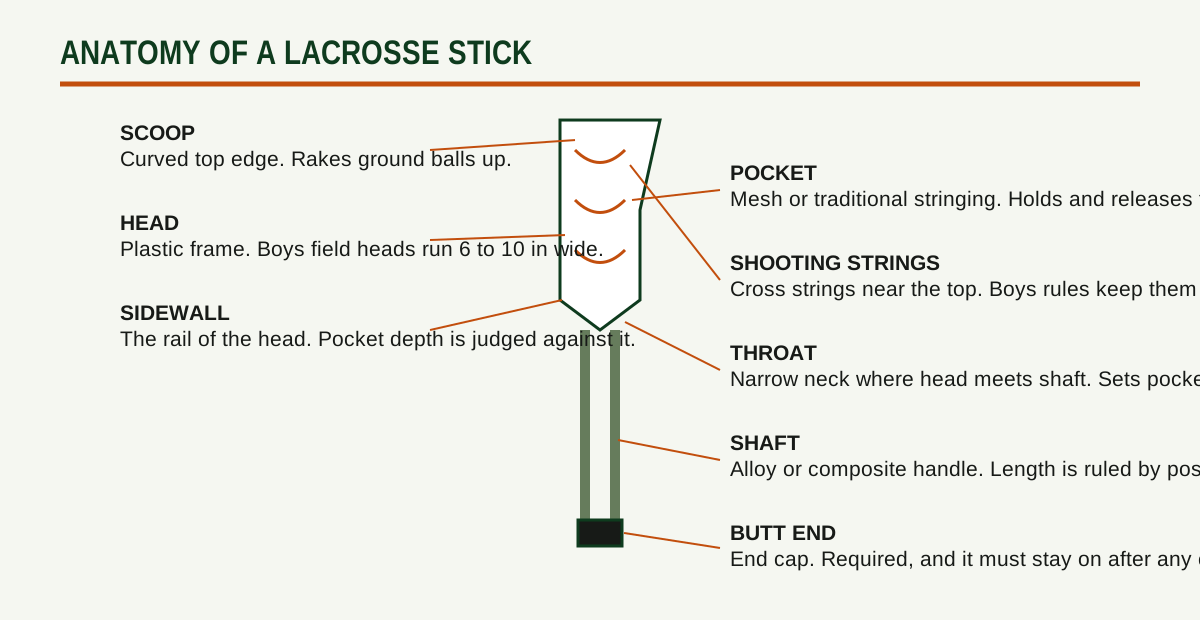
The head is the plastic frame at the top. It includes the scoop, which is the curved top edge used to pick up ground balls, the sidewalls that form the sides of the pocket, and the throat, which is the narrow section where the head meets the shaft. A wider head gives a bigger catching area. A narrower head helps an experienced player protect the ball and shoot with more precision.
The pocket sits inside the head. It is formed by mesh or by traditional strings, along with sidewall strings and shooting strings near the top. The pocket controls how the ball sits, how it releases on a throw, and how securely it stays during a cradle. Two sticks with the same head can feel completely different if their pockets are strung differently.
The shaft is the long handle, usually made from metal alloy or composite material. Alloy shafts are strong and common for youth players. Composite shafts can be lighter and absorb vibration differently. Near the bottom of the shaft is the butt end, a small cap that keeps the stick from slipping through the hands and protects the end of the shaft.
Labeled diagram of a lacrosse stick showing the scoop, head, sidewall, pocket, shooting strings, throat, shaft, and butt end
Head shape, width, and what the numbers mean
USA Lacrosse stick specifications put numbers on the head. In the boys game, a field head measures 6 to 10 inches wide at its widest point, with sidewalls no more than 2 inches tall. In the girls game, the head measures 7 to 9 inches wide. A goalie head in either game may be up to 12 inches wide, which is why goalie sticks look like snow shovels next to field sticks.
Width is a trade that a buyer makes on purpose. A head near the wide end of the legal range catches on a bigger target and scoops ground balls with a forgiving angle, which is exactly what a first or second year player needs. A head near the narrow end holds the ball in a tighter channel, so a skilled carrier can run through stick checks without the ball rattling out, and the release point stays in the same place on every throw. Neither choice is better in the abstract. The right choice is the one that matches the hands that will use it this season.
The pocket is a system, not a part
Coaches talk about the pocket as if it were one thing, but four elements work together. The mesh or traditional runners form the bag itself. The sidewall strings set how deep that bag hangs. The shooting strings near the top shape the release, adding a small ramp that the ball rolls over as it leaves. The bottom string sets how low the ball rests when the stick hangs vertical.
Change any one element and the throw changes. Tighten the shooting strings and the ball releases later and higher, which players call whip. Loosen the sidewalls and the bag deepens, which holds the ball better and breaks the pocket depth rule in both games if it goes too far. A parent who understands the system can fix a bad throw with one string adjustment instead of buying a new stick.
Find Your Legal Length Before You Shop
Interactive tool
Stick Finder: Legal Length by Game, Age, and Position
Pick your game, age group, and position. Lengths come from the USA Lacrosse equipment guide and youth rules compiled for this site. Local leagues can modify them, so confirm with your coach before you cut a shaft.
40 to 42 inches overall
That is the legal complete stick range, head plus shaft plus end cap, for a boys 12U attack player.
Regulation short stick range from 12U up, per the USA Lacrosse equipment guide.
Coaching convention, not a rule: for a player 54 inches tall, start near 42 inches, close to the low end of the legal range, and only move up as stick control improves. A stick the player cannot hold head up with one hand is too long or too heavy, whatever the tape says.
Head and pocket notes: boys field heads run 6 to 10 inches wide with a pocket that fails if the top of the ball sits below the bottom edge of the sidewall. Girls field heads run 7 to 9 inches wide with a shallower pocket; at 12U and up the top of the ball must show above the sidewall. Goalie heads may be up to 12 inches wide in both games. Source: USA Lacrosse equipment guide and youth rules.
The finder above encodes the stick length rules compiled from the USA Lacrosse equipment guide for the 2026 seasons and the USA Lacrosse youth rules. Two ideas in it deserve emphasis. First, every length in lacrosse is an overall length: head, shaft, and butt end together, measured with the stick fully assembled. A shaft sold as 30 inches is not a 30 inch stick. Second, the youngest levels run on allowances rather than fixed numbers. At boys 6U, USA Lacrosse guidance caps the stick at the distance from the ground to the player waist. At girls 10U and below, smaller sticks are permitted and the pocket rule relaxes, which the next sections explain.
Legal Stick Lengths by Game, Division, and Position
The table below is the compiled reference for this page. Credit: compiled by OYLAX from the USA Lacrosse Equipment Guide for the 2026 Boys, Girls, and Box/Indoor Seasons and the USA Lacrosse boys and girls youth rules. Local leagues may adopt modifications, so treat this as the national framework and confirm your league version before a purchase.
Game
Age group
Attack and midfield
Defense
Goalie
Boys
6U
Ground to waist maximum, no minimum
Short stick only
Short stick only
Boys
8U
37 to 42 inches
Short stick only, no long poles
37 to 54 inches
Boys
10U
37 to 42 inches
47 to 54 inches, team limit applies
37 to 54 inches
Boys
12U
40 to 42 inches
52 to 72 inches
40 to 72 inches
Boys
14U
40 to 42 inches
52 to 72 inches
40 to 72 inches
Boys
High school and up
40 to 42 inches
52 to 72 inches
40 to 72 inches
Girls
8U and 10U
Smaller sticks allowed, league confirms
Same field stick, no long poles
35.5 to 52 inches at 10U
Girls
12U
35.5 to 43.25 inches
35.5 to 43.25 inches
35.5 to 52 inches
Girls
14U
35.5 to 43.25 inches
35.5 to 43.25 inches
35.5 to 52 inches
Girls
High school and up
35.5 to 43.25 inches
35.5 to 43.25 inches
35.5 to 52 inches
Read the defense column carefully, because it carries the single biggest structural difference between the two games. Boys lacrosse has a long pole: from 12U up, defenders and one midfielder may carry a stick of 52 to 72 inches, and a team may have no more than four long crosses on the field at one time. Girls lacrosse has no long pole at any age. A girls defender carries the same 35.5 to 43.25 inch stick as a girls attacker, and wins her matchup with footwork, body position, and angles instead of reach.
Types of Sticks by Position
Attack players usually use a standard length stick with a head that balances catching and ball control. Attackers work close to the goal, so they value quick hands and accurate passing and shooting.
Midfielders also use a standard length stick, but they cover the whole field. Their stick needs to handle offense, defense, and ground balls in transition. Many midfielders choose a slightly sturdier head that can handle checks and repeated scooping.
Defenders use a much longer shaft. The extra length helps them reach to intercept passes, poke check the ball carrier, and keep distance between the attacker and the goal. A defensive stick is harder for a young or small player to control, so it should only be used when a coach assigns that position and the player is tall and strong enough to handle it.
Goalies use a much wider head, paired with a shaft longer than an attack shaft but shorter than a full defensive shaft. The wide head gives a larger blocking surface against direct shots. Faceoff specialists in the boys game use a specialized flexible head designed to clamp the ball at the faceoff X, then often hand the ball off and leave the field, a role nicknamed FOGO for face off, get off.
A worked example: sizing three siblings
Consider one family with three players starting the same spring season. The eight year old boy enters 8U. His legal window is 37 to 42 inches, and the practical pick is a complete stick at 37 or 38 inches, because every extra inch is leverage working against small hands. His eleven year old sister enters girls 12U, where the window jumps straight to the full regulation range of 35.5 to 43.25 inches. She picks 40 inches, mid range, and spends her adjustment time on the pocket test rather than on length. Their fourteen year old brother makes a 14U boys roster as a defender. His window is 52 to 72 inches, but his coach starts him at 60 inches, not the maximum, because a 72 inch pole that a player cannot withdraw after a poke check is a liability, not an advantage. Three kids, three rule windows, three different correct answers, and none of them is the longest stick in the shop.
Boys Sticks Compared With Girls Sticks
The biggest difference is the pocket. In the girls game, rules require a shallower pocket, so the top of the ball must remain visible above the sidewall when the stick is held flat and viewed from the side. In the boys game, a deeper pocket is allowed, and the test is different: a boys pocket fails only when the top of the ball sits below the bottom edge of the sidewall. A deeper pocket holds the ball more securely during physical play, but it also changes the release point on throws.
Girls heads are often narrower and designed for a quicker release and more finesse. Boys heads vary more by position and can be built for harder checks. Shaft lengths also follow different rule sets, so you should never assume a boys stick is legal for a girls game. Always confirm legality with a coach before the first practice. USA Lacrosse also maintains a published list of legal womens sticks, and from the high school level up, a girls stick should be a model on that list.
Catalogue plate for lacrosse gear and equipment guides on OYLAX
How a Stick Is Sized
Length is measured for the complete stick, head plus shaft. Youth players often start with a shorter stick that is easier to control. A simple fitting check is to stand the stick upright beside the player with the scoop on the ground. For a young beginner, the top of the stick should land roughly between the hip and the chest. If the stick towers well above the shoulder, it will be hard to handle. Treat that check as a coaching convention for comfort, not a legality test. Legality comes only from the tape measure and the table above.
Coaches sometimes cut an alloy shaft down to fit a smaller player. An adult should do the cutting and replace the butt end afterward, because a stick without its end cap is illegal and the exposed metal edge is sharp. Never cut below the minimum length for the level of play: a 12U boys stick cut to 39 inches for comfort is a stick that fails inspection. Weight matters too: if the player struggles to keep the head up with one hand, the stick is too heavy or too long.
Edge cases that surprise buyers
Three situations catch families every season. First, the hand me down trap: an older sibling boys stick passed to a younger sister is illegal in her game no matter how shallow the pocket looks, because the head and pocket specifications differ. Second, the bargain long pole: a 72 inch defensive stick bought for a 10U player exceeds his 54 inch cap, and no coach can waive that. Third, the cut too far goalie stick: a boys goalie may use anything from 40 to 72 inches, so a cut down goalie shaft is legal across a wide range, but a field player who borrows that same stick at 46 inches owns an illegal field stick, because field ranges have hard maximums at both ends.
How Stringing Changes Everything
Stringing is the most overlooked part of buying a stick. A well strung pocket lets the ball sit in the sweet spot, releases smoothly on a pass, and stays consistent from throw to throw. A poorly strung pocket can hook shots upward, drop passes downward, or rattle loose during a cradle.
Factory strung complete sticks are the best starting point for most youth players because the pocket is ready to use and usually legal out of the bag. Custom stringing becomes useful later, when a player knows whether they like a higher or lower pocket and a faster or slower release. Any pocket will stretch and loosen with use, heat, and rain, so plan to have it checked and adjusted during the season. Mesh bags in wet weather are the classic case: a pocket that passed inspection on a dry Saturday can hang measurably deeper after a rainy tournament, and the fix is a tightened bottom string, not a new head.
Choosing the Right Stick for a Beginner
Start with a complete stick made for the correct game, boys or girls, and for field play rather than a specialty position. Choose a head with a forgiving shape, a factory pocket that throws straight, and a shaft the player can control with one hand. Avoid buying a specialty defensive or goalie stick before a position is settled.
Bring the player to try the stick if you can. Ten wall ball throws tell you more than any product description. If the ball releases cleanly and ground balls come up without digging, the player can learn the game instead of fighting the equipment.
Interactive tool
Pre-Purchase Stick Check
Check off each step as you finish it. Your progress stays on this page.
0 of 9 complete
0% done
Run the checklist above with the actual stick in hand, in the shop or at home during the return window. It takes four minutes, and it catches the three failures that account for most returns: wrong game, wrong length, and a pocket that throws somewhere other than where the player aims.
Frequently Asked Questions
What is the standard length of a lacrosse stick?
It depends on game, age, and position. From 12U up, a boys attack or midfield stick measures 40 to 42 inches overall, a boys long pole measures 52 to 72 inches, and a girls field stick measures 35.5 to 43.25 inches. Younger boys divisions allow 37 to 42 inch short sticks. All figures come from the USA Lacrosse equipment guide and youth rules.
Can a girl use a boys lacrosse stick in a girls game?
No. The head shape, pocket depth rule, and length range all differ, and officials check pockets in the girls game. Buy a womens model, and at high school level confirm it appears on the USA Lacrosse legal womens sticks list.
How is stick length measured?
Overall, with the stick fully assembled: the top of the scoop to the end of the butt cap. A bare shaft measurement is not the stick length, and a stick measured without its end cap reads short and plays illegal.
What makes a pocket illegal?
In the boys game, the pocket is too deep when the top of a ball placed in it sits below the bottom edge of the sidewall. In the girls game at 12U and up, the top of the ball must remain visible above the sidewall with the stick held flat, and the ball must fall out freely when the stick is turned upside down.
Should a beginner buy a complete stick or separate parts?
A complete stick. Factory stringing gives a legal, consistent pocket on day one, and the head and shaft are matched for length. Separate parts make sense once a player knows the pocket shape and head width they prefer.
Can you cut a lacrosse shaft to make a stick shorter?
Yes, within the legal range for the division, and an adult should do it. Remove the butt end, cut the shaft, deburr the edge, and refit the cap. Never cut below the division minimum: 40 inches overall for boys 12U field players is a floor, not a suggestion.
How wide is a goalie lacrosse head?
Up to 12 inches at the widest point in both the boys and girls games, compared with 6 to 10 inches for a boys field head and 7 to 9 inches for a girls field head, per USA Lacrosse specifications.