Lacrosse Goalie: The Position, the Crease, and the Skills That Define It
By the OYLAX Lacrosse Guide editorial team
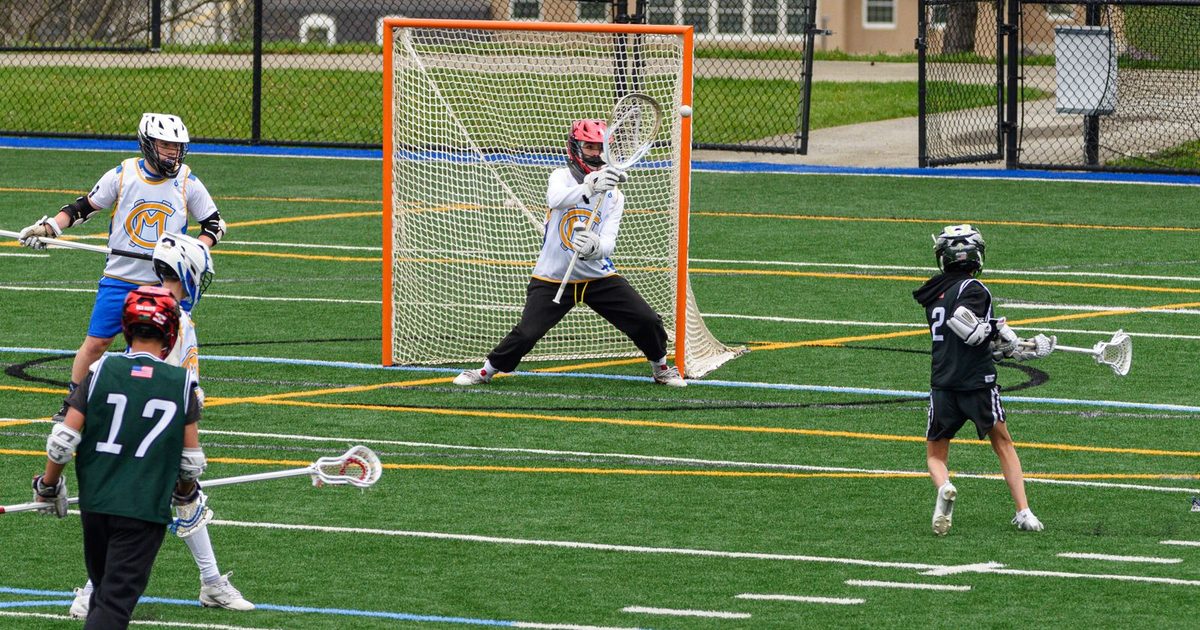
Photo: Jay Brand / Pexels
The Last Line and the First Pass
The lacrosse goalie is the most specialized position on the field. Every other player defends space and opponents; the goalie defends a goal that is 6 feet by 6 feet, standing inside a circular crease that attackers may not enter. A goalie who plays well does four jobs at once: stops shots, directs the defense, starts the offense with the clear, and steadies the whole team emotionally after goals for and against.
That combination explains why coaches protect their goalies in selection and in practice. A team can survive a weak wing. It cannot survive a goalie who cannot see the ball, cannot throw the clearing pass, or goes quiet after the third goal. This page covers the position the way a season teaches it: the rules that fence the crease, the stance and the arc, the save itself, the clear, the voice, the equipment the rulebook demands, and a practice planner built for the position. Equipment standards and crease rules here are compiled from the USA Lacrosse equipment guide for the 2026 seasons and the USA Lacrosse youth rules, credited where they appear.
The Crease Rules That Shape Everything
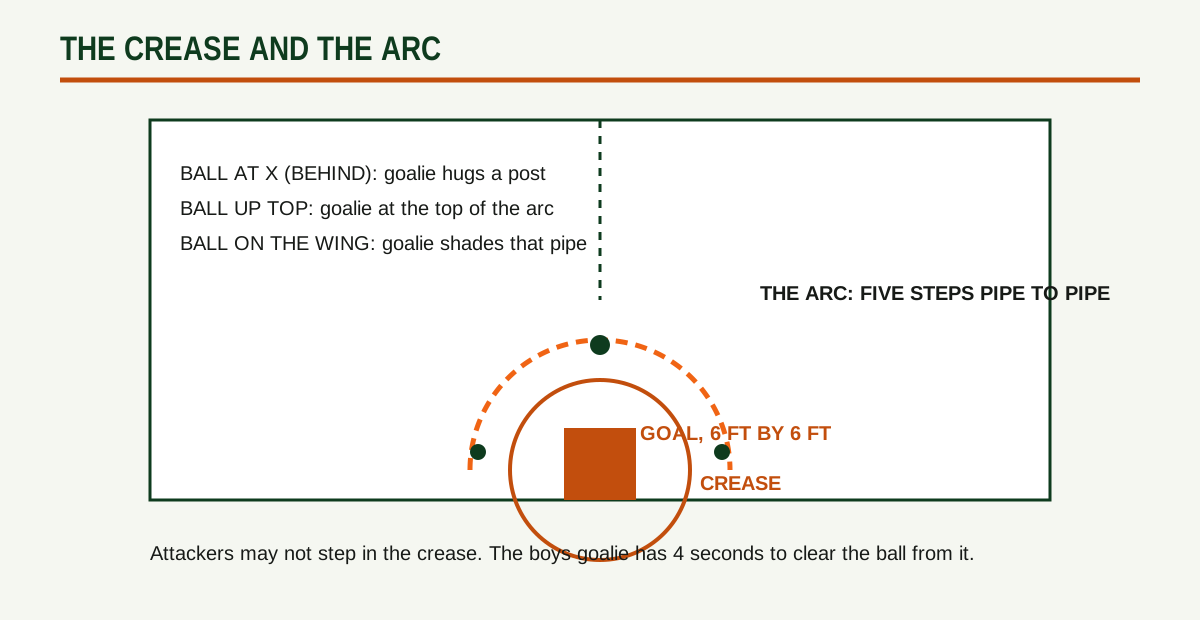
Three rules define the goalie working conditions. First, attackers may not step into the crease, and a goal scored with the shooter or a teammate inside it is disallowed. The crease is the one patch of field where the goalie cannot be crowded legally. Second, the goalie is the only player allowed to touch the ball with a hand, and only inside the crease, and only to block it. A goalie who picks the ball up by hand, even in the crease, has broken the rule. Third, possession in the crease runs on a clock. In the boys game the goalie has four seconds to pass or carry the ball out. In the girls game the goalkeeper has ten seconds to clear the crease.
A fourth rule follows the goalie everywhere: leave the crease and the privileges stay behind. A goalie who carries the ball upfield is a field player for checking and contact purposes, which is why goalie runs past midfield are rare, celebrated, and coached with great care.
Diagram of the goalie crease, the goal, and the arc the goalie walks as the ball moves
Stance and the Arc
Everything a goalie does starts from a ready stance: feet a little wider than the shoulders, knees bent, weight on the balls of the feet, hands in front of the body with the stick head up near chin height and the pocket facing the ball. From that stance the goalie walks the arc, an imaginary curved line across the front of the crease. The arc has five working positions, from one goal post to the other, and the goalie matches position to ball location. Ball behind the goal at X: hug the near post and watch for the roll. Ball on the wing: shade that side pipe. Ball at the top: take the middle step at the top of the arc, cutting the angle down.
Angle play is the quiet mathematics of the position. Every step forward on the arc shrinks the goal the shooter can see. Every step too far invites a shot past the ear or a feed to the back side. Young goalies get beaten most often not by shot speed but by standing flat on the goal line, defending a six foot goal with a three foot body and hoping.
The Save: Hands, Step, Body
A save is a sequence, not a flinch. The eyes pick up the ball at the release, not at the stick fake before it. The top hand drives the stick head to the ball. The near foot steps toward the shot line. The body follows the stick, so a ball that beats the pocket still hits a chest, a thigh, or a glove. Coaches summarize it as hands, step, body, in that order, and drill it until the order survives a ninety mile an hour shot.
High shots ask the goalie to stay tall and punch the top hand up without dropping the hips. Low shots ask for the head of the stick to get down early and the body to drop behind it. Bounce shots, the hardest read in the sport, ask for patience: read where the ball bounces, because the bounce, not the release, decides the final direction. Off stick side shots beat beginners who hold the stick in the middle of the body; the fix is a stance with the stick already shading the off stick hip at rest.
Rebounds and the Second Shot
The save is not the end of the play. A ball dropped in front of the crease is a second shot waiting to happen, and crease attackers live on exactly those rebounds. Good goalies smother low saves, kick or sweep loose balls away from the crease front, and call for defensive help with a single word the whole unit knows. Defenders answer by clearing bodies out of the crease area, legally, with position and box outs rather than shoves, because a defensive foul beside your own goal hands the offense a free restart at point blank range.
The Clear: Where Goalies Win Games Quietly
After the save and the four second or ten second count, the goalie becomes a quarterback. The clear must move the ball from the defensive end over midfield before the count and the riding attackers close the lanes. Goalies scan during the shot, not after it, so the first outlet choice is already made when the ball lands in the pocket. The standard picture: two defenders breaking wide to the corners, two midfielders streaking to the midfield line, and one safe outlet back near the crease as the release valve.
A goalie who throws accurately to the midfield line turns defense into transition offense, the most valuable play in the sport. A goalie who hesitates turns a save into a turnover at the worst address on the field. Clearing is therefore trained like a shooting skill, with targets, reps, and a clock, which is why the planner below pairs reaction work with save and clear work in the same block.
The Voice of the Defense
The goalie sees what no defender can: the whole play, ball side and back side, from behind the unit. That view makes the goalie the caller. The vocabulary is short and loud: ball position on every pass, a slide call when a dodger beats his man, a hold call when the defense should stay home, and a check call when a feeder looks away. Defenders trust a goalie who talks early and specifically, and they drift toward a goalie who only talks after goals.
Build a Goalie Practice Block
Interactive tool
Drill Planner: Build a Timed Practice Block
Choose a focus and a session length. The planner assembles a timed block from a bank of standard coaching drills, each with its setup and coaching point.
30 minute block, 4 drills
Add five minutes of water and reset time between drills in a real practice. Scale shooter speed to the level of the group before scaling volume.
Drill
Minutes
Setup
Coaching point
Pipe to Pipe Arc Steps
6
Goalie in the crease, coach at eight yards with six balls. Goalie steps the arc from pipe to pipe on each call.
Move on the ball, not on the shot. Small steps, stick stays in front of the chest.
High to Low Reaction Saves
8
Shooter alternates high and low corners from ten yards at half speed, then full speed.
Drive the top hand to the ball and step with the near foot. Body follows the stick.
Bounce Shot Reads
8
Shooter bounces every shot from twelve yards, varying the bounce point.
Read the bounce, not the stick. Get the head down early and smother the rebound.
Save and Clear Sprint
8
After each save the goalie must hit one of two clearing targets at midfield within four seconds.
The save is half the job. Scan during the shot so the outlet choice is already made.
The planner above loads the goalie reaction bank by default: arc steps, high to low reads, bounce shot work, save and clear sprints, screen shot chaos, and crease roll stops. Pick a session length and it assembles a timed block with setups and coaching points. Scale shooter speed before volume with young goalies. A twelve year old facing full speed shots for thirty minutes learns to flinch, not to save.
Goalie Equipment: Required and Optional
Credit: compiled by OYLAX from the USA Lacrosse Equipment Guide for the 2026 Boys, Girls, and Box/Indoor Seasons. Certification marks are printed on the equipment itself, so verify each item at purchase.
Item
Boys goalie
Girls goalie
Governing standard or note
Helmet with face mask
Required
Required
Must carry the statement or seal showing it meets the NOCSAE lacrosse standard and is SEI certified
Throat guard
Required
Required
Separate from the helmet, attached with snaps, screws, or other fasteners
Chest protector
Required
Required
Must meet the NOCSAE ND200 standard; covers the front torso from the neckline to below the navel
Goalie gloves
Required
Required
Goalie models add extra thumb protection over field gloves
Mouthguard
Required
Required
Self molding or custom molded
Protective cup
Required
Not listed for girls goalies
Fitted for comfort and protection
Thigh pads
Not listed for boys goalies
Required
Integrated protective padding; field hockey goalie pads may not be used
Goalie stick
Required, 40 to 72 inches
Required, 35.5 to 52 inches
Head up to 12 inches wide in both games
Shoulder pads
Optional
Optional
Must cover the top of the shoulder, collarbone, and sternum when worn
Shin protection
Optional
Optional
Padding may not exceed one inch in thickness
Rib pads
Optional
Optional
Covers the ribs and kidneys, must not restrict breathing
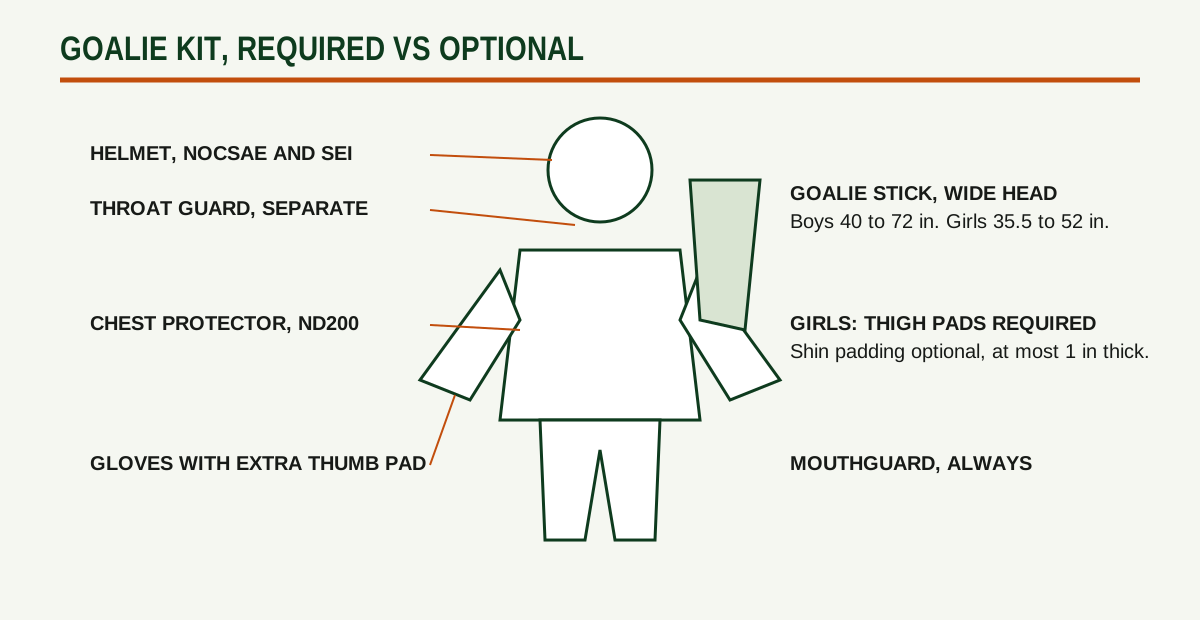
Diagram labeling required lacrosse goalie equipment and its standards
The ND200 line in that table deserves a sentence of its own. NOCSAE ND200 is the performance standard for lacrosse chest protection written against commotio cordis, the cardiac arrest a hard blow over the heart can cause. USA Lacrosse requires it in goalie chest protectors in both games, and in boys shoulder pads for field players as well. An old hand me down chest protector without the ND200 mark is not legal gear, however good it looks.
Choosing a Goalie Stick
Interactive tool
Stick Finder: Legal Length by Game, Age, and Position
Pick your game, age group, and position. Lengths come from the USA Lacrosse equipment guide and youth rules compiled for this site. Local leagues can modify them, so confirm with your coach before you cut a shaft.
40 to 72 inches overall
That is the legal complete stick range, head plus shaft plus end cap, for a boys 12U goalie player.
Goalie crosse range per the USA Lacrosse equipment guide.
Coaching convention, not a rule: for a player 54 inches tall, start near 54 inches, close to the low end of the legal range, and only move up as stick control improves. A stick the player cannot hold head up with one hand is too long or too heavy, whatever the tape says.
Head and pocket notes: boys field heads run 6 to 10 inches wide with a pocket that fails if the top of the ball sits below the bottom edge of the sidewall. Girls field heads run 7 to 9 inches wide with a shallower pocket; at 12U and up the top of the ball must show above the sidewall. Goalie heads may be up to 12 inches wide in both games. Source: USA Lacrosse equipment guide and youth rules.
The finder above opens preset to the goalie position. The boys range runs 40 to 72 inches and the girls range 35.5 to 52 inches, both with heads up to 12 inches wide. Within those ranges, most youth goalies play best in the lower half. A shorter goalie stick moves faster between save positions and clears with a quicker release, and the reach a long shaft adds matters only once a goalie is strong enough to control it one handed on outlet throws. String the pocket with a smooth, consistent channel rather than a deep bag: a deep goalie pocket swallows rebounds nicely and then refuses to release the clearing pass on time.
A Worked Example: Reading One Possession
Watch a single settled possession the way a goalie lives it. The ball starts with an attacker at the top of the box. The goalie calls the position, steps to the top of the arc, and shows the shooter a small goal. The pass goes to the wing. The goalie slides two steps toward that pipe, calls the new position, and hears the crease defender answer. The wing attacker dodges hard down the alley. The goalie holds the near pipe, because the alley dodge has one dangerous finish and three harmless ones, and the harmless ones all end with a weak shot across the body.
The dodge draws the slide. Now the ball moves twice in a second: back to the top, then across to the far wing, where a midfielder catches with time to wind up. This is the shot the whole possession was building, and the goalie job on it was done half a second earlier, during the second pass, when the feet reset to the far side of the arc and the stick came back to chin height. The save, when it comes, looks easy. It was not easy. It was early. Goalie coaches grade possessions exactly this way: not on the save at the end, but on whether the goalie was set, square, and talking before the shot existed.
Warming Up a Goalie the Right Way
A goalie warm up is a skill session in disguise, and the order matters. Start with arc steps and no ball, so the feet learn the five positions cold. Add soft tosses to the stick side, then the off stick side, at a speed the goalie handles cleanly. Move to half speed shots, high then low then bouncing, one family at a time, so the reads stay separate. Finish with a short burst of full speed shots and a set of clearing throws to real targets. Ten disciplined minutes of that sequence teaches more than thirty minutes of a team shooting drill, where the goalie faces random shots while tired and learns mostly to guess. Never warm a youth goalie up with the hardest shooters on the team going first. Confidence is a technique issue at this position, and it is built in the first twenty saves of the day.
The Mental Side Coaches Actually Train
Goalies are scored on in public, alone, with a horn. The position therefore trains a reset ritual like any other skill. The common one: after a goal, the goalie retrieves the ball, takes one breath at the back of the crease, names the next job out loud, and steps back to the arc. Teams add a physical reset, a tap of both posts, so the ritual survives noise. What a goalie may not do is carry the last goal into the next shot. Shooters can smell a goalie who is replaying a mistake, and they shoot at him first.
Parents help most by keeping the car ride simple. Save percentages at the youth level swing wildly with shot quality, and a goalie who faced nine crease shots played a harder game than one who faced nine outside rips, whatever the scorebook says.
Frequently Asked Questions
How long does a goalie have to clear the ball from the crease?
Four seconds in the boys game and ten seconds in the girls game, counted from gaining possession inside the crease. The count is why clearing practice runs on a clock.
Can the goalie touch the ball with a hand?
Yes, inside the crease only, and only to block or deflect the ball. The goalie may not pick the ball up, catch it, or control it with a hand.
What size stick does a lacrosse goalie use?
A boys goalie stick measures 40 to 72 inches overall and a girls goalie stick 35.5 to 52 inches, with a head up to 12 inches wide in both games, per the USA Lacrosse equipment guide. Most youth goalies play in the lower half of those ranges.
What chest protector does a goalie need?
One that meets the NOCSAE ND200 standard, in both the boys and girls games. Check for the NOCSAE statement and the SEI certification mark on the product, and confirm the protector covers from the neckline to below the navel.
Can a goalie leave the crease and run the ball upfield?
Yes, but the crease privileges end at the crease line. Outside, the goalie is treated as a field player, including for contact, and the team must still respect the offside count.
Do girls goalies wear different equipment from boys goalies?
Mostly the same core: helmet, separate throat guard, ND200 chest protector, goalie gloves, and a mouthguard. The girls list adds required thigh pads and allows optional shin protection up to one inch thick, while the boys list includes a protective cup.
What is the most important goalie skill for a beginner?
Positioning on the arc, because it is the only skill that works on every shot, including the ones too fast to react to. A beginner in the right place with an average stick makes saves that a quick beginner standing on the goal line never reaches.