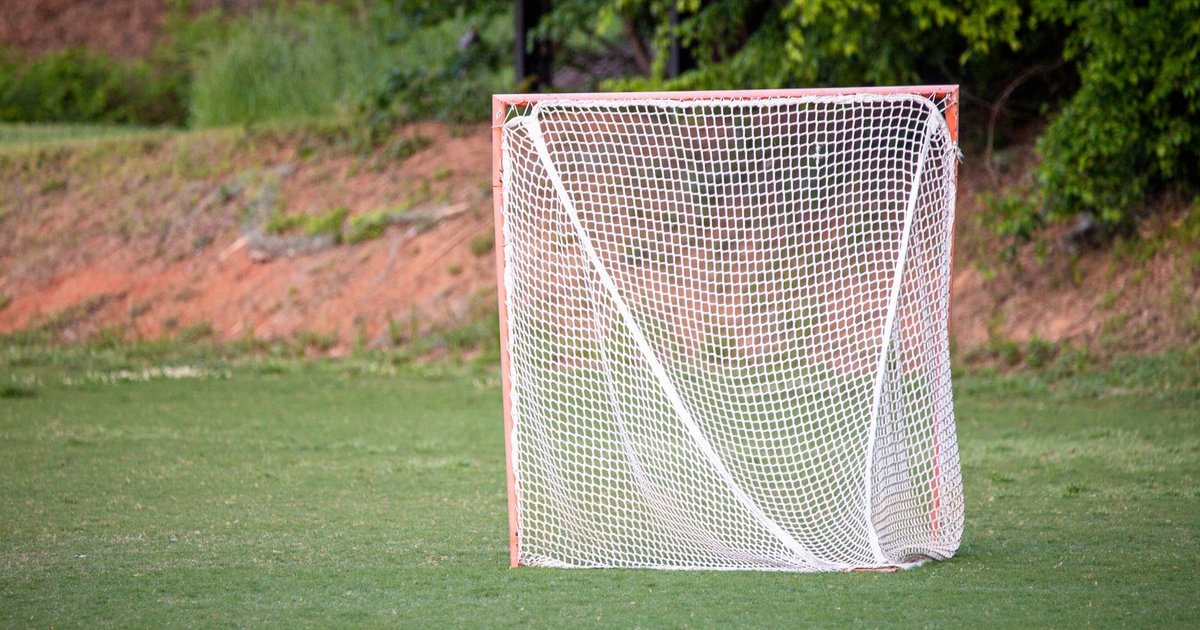
The Full Size Field, in Numbers First
A full size boys lacrosse field measures 110 yards long and between 53 1/3 and 60 yards wide. Goals stand on goal lines set inside each end of the field, the goals themselves measure 6 feet wide by 6 feet tall, and a crease circle with a radius of 9 feet surrounds each goal. A midfield line cuts the field in half, restraining boxes structure each end, wing areas mark the midfield sides, and a substitution box sits at midfield in front of the scorer table. Set up in the right order, a field crew can line a bare pitch in under an hour. Set up in the wrong order, the same crew repaints twice. This page gives the order, the measurements that matter, and the youth adjustments that shrink the whole plan honestly.
Work from fixed points outward: goals and creases first, because everything else references them, then the boxes, then the midfield furniture, then a walking inspection with fresh eyes.
Step by Step: From Bare Grass to Game Ready
- Walk the full rectangle and mark the four corners. Confirm the length at 110 yards and the width inside the allowed band before any line goes down.
- Place each goal on its goal line, centered across the width, with the front posts sitting exactly on the line and the goal mouth facing midfield.
- Anchor both goals so they cannot tip: pegs on grass, weighted bases on turf, every time, even for practice.
- Paint or mark the crease circle around each goal at a 9 foot radius, centered on the middle of the goal line inside the frame.
- Mark the restraining box at each end: the area the attack and defense must respect on restarts, bounded by the box lines your rulebook specifies for your level.
- Mark the goal area and defensive clearances your league requires, then the wing areas beside the restraining boxes at midfield side.
- Lay out the midfield line, the center faceoff markings, and the substitution box in front of the scorer table at the center stripe.
- Set the penalty area beside the substitution box, place the table, timer, and horn, and walk the player benches into their spots.
- Finish with the inspection walk in the checklist below, fixing anything the walk catches before teams arrive.
The Markings and What Each One Governs
| Marking | Where it sits | What it controls |
|---|
| Goal line | Across each end, through the goal posts | Scoring plane and goal placement |
| Crease circle | 9 foot radius around each goal | Attacker exclusion, goalie protection |
| Restraining box | Each end of the field | Who must stay in on restarts, offside counting |
| Wing area | Beside each restraining box at midfield | Faceoff wing starting positions |
| Midfield line | Center of the field | Offside counts, faceoff location |
| Substitution box | Midfield, in front of the table | Legal player exchanges |
| Penalty area | Beside the substitution box | Where penalized players serve time |
New volunteers often treat the boxes as decoration. They are working rules drawn on grass. A wing area painted two yards out of place changes faceoffs. A restraining box marked carelessly changes restarts. Measure the furniture with the same care as the goals, because officials will judge restarts by your lines all afternoon.
Goals, Nets, and the Safety Pass
The goal frame is the only heavy equipment on the field, and it earns a safety pass of its own. Check that the frame sits flat with no bent post, that the net is laced with no gaps at the edges where a ball could slip through and confuse a call, and that the net tension has some give so hard shots drop inside rather than rebounding out. Confirm the anchoring twice: once when the goal is placed and once after warmups, when players have been leaning, shooting, and occasionally hanging where they should not. Nobody climbs on a crossbar, ever, and a crew that enforces that rule during setup saves itself the worst phone call in youth sports.
On shared fields, expect to inherit someone else lines. Soccer markings in another color are a fact of multi use life. Lacrosse lines should be one consistent color for the day, and captains and officials should agree at the coin talk about which set of lines governs any confusing overlap near the boxes.
Youth Fields: Smaller on Purpose
Youth divisions do not play the full field with full rosters. USA Lacrosse youth formats shrink both the dimensions and the player counts as age drops, moving from the full 110 yard field at the oldest youth levels down through reduced fields at 12U and 10U to small sided formats on short fields at 8U and 6U. The exact dimensions and roster sizes for your division come from your league format sheet, and a good crew asks for that sheet before painting anything in March.
The setup principles survive the shrink. Goals centered and anchored. Creases marked at the radius your format uses. Restraining structures scaled to the smaller field. A substitution area the table can actually supervise. What changes is arithmetic, not care: a small field set up sloppily teaches small players the wrong spacing, and they carry those pictures for years.
The Morning Of: A Realistic Crew Timeline
For a volunteer crew of three on a familiar field, a workable convention is ninety minutes before the first faceoff. The first thirty minutes place goals, creases, and boxes. The next twenty handle midfield furniture, benches, and the table. The next twenty belong to the inspection walk and repairs. The final twenty are buffer, because something always needs buffer: a paint machine clogs, a net lace snaps, a coach asks for a practice goal moved. Tournaments compress this by pre marking fields the day before, and any program that hosts regularly learns to paint once on Friday rather than heroically at dawn on Saturday.
Keep a setup kit with the field gear: two long tapes, string and stakes for straight lines, spare net lacing, a wrench for goal hardware, extra cones for a damaged line, and the league format sheet in a plastic sleeve. The kit turns setup from a scavenger hunt into a routine, and routines are what make a field look identical in week one and week nine.
Weather, Wear, and the Midseason Refresh
Outdoor fields live hard lives between March and May, and a setup that was crisp on opening day degrades on a schedule a crew can predict. Painted lines on grass fade to suggestion in about two weeks of sun and mowing, faster in rain. The restraining boxes and creases wear first because traffic concentrates there, so a midseason refresh should repaint high traffic markings a week before the cosmetic ones. A crew that repaints everything on the same day wastes paint on lines nobody steps on and leaves the crease thin for the biggest game of the month.
Turf fields trade painting for inspection. Seams lift near the crease, inlay edges curl at the corners, and a lifted seam is a twisted ankle waiting for a goalie to back into it. Walk the seams with a toe drag during setup; your shoe finds what your eyes miss. Portable goals on turf also wander more than goals on grass, because nothing pins them, so re-square the cages after warmups as well as before them.
Keep a field book, even a single page in the scorebook: date, crew, paint used, problems found, problems fixed. Programs inherit fields from last year volunteers, and the book is how this year crew learns that the north goal always sits two inches shallow or that the midfield paint from April is under the May lines by a foot. Setup is a craft with a memory. Write it down and the field gets easier every season instead of merely older.
The Youth Field Exception Worth Knowing
Families setting up fields for the youngest divisions should expect one legitimate difference from the dimensions above. Many youth leagues shorten the field for the smallest age bands so that eight year olds can reach the far end before exhaustion, and some play with fewer players per side on the reduced surface. The markings shrink proportionally, and the crease, the boxes, and the substitution area keep their relationships to each other. When your league sends a youth field diagram, set up from that diagram rather than from memory of the full size field, and measure twice before painting, because a youth field painted at senior spacing wastes the entire design in a single afternoon.
Tournament hosts add one more wrinkle. A site running four youth games at once may paint two small fields across one full field, sharing the midfield stripe as a boundary. In that layout the goals face sideways relative to the stadium, the benches sit in unusual places, and the setup crew earns its coffee. Walk any shared layout with the tournament director before the first whistle and confirm which lines belong to which game, since two crews painting from two diagrams on one surface is how fields acquire mysterious extra boxes.
Frequently Asked Questions
How big is a boys lacrosse field?
The full size field is 110 yards long and 53 1/3 to 60 yards wide, per the USA Lacrosse boys youth rules for the full field game. Youth divisions play on reduced fields with fewer players, sized by the league format for each age group, so confirm your division dimensions before marking.
How far apart are the two goals?
The goals sit on their goal lines inside the ends of the 110 yard field, centered on the width, with a 9 foot crease circle around each. Midfielders run the full distance between the two restraining boxes on every clear and ride, which is why the midfield line and the boxes matter as much as the goals in a proper setup.
What is the crease, and how big is it in the boys game?
The crease is the circle around the goal, with a radius of 9 feet in the boys game. Attackers may not step into it, defenders may run through their own crease, and the goalie inside it receives specific protections, including a four second count to move the ball after gaining possession in the crease.
Who is responsible for field setup at a youth game?
Usually the home program: a field crew or trained volunteers place goals and lines, while officials inspect the field before play and can require fixes to anything unsafe or clearly wrong. Coaches should walk the field during warmups and raise problems early, when they are still five minute repairs.
What if our field is shorter than 110 yards?
School and park fields sometimes force an adjustment. Programs handle it by agreement between the leagues or coaches involved, shortening the midfield section rather than shrinking the boxes and creases, so the game near each goal plays true. Whatever is agreed, both teams and the officials should hear it before warmups begin.