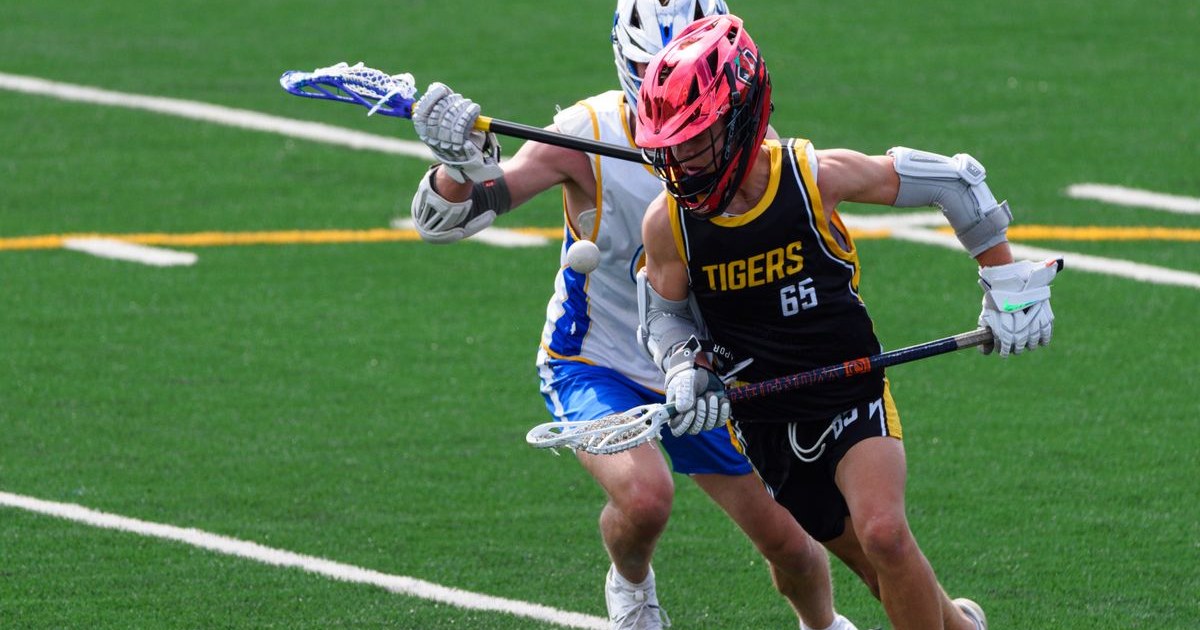
What Makes the Boys Game Different
Boys field lacrosse is a contact game played 10 against 10 on a field about 110 yards long and 60 yards wide. Players carry the ball in the pocket of a stick, pass, catch, scoop ground balls, and shoot on a goal that is 6 feet by 6 feet inside a circular crease. The defining feature of the boys game is legal physical contact. Body checking and stick checking are part of defense, but both are tightly limited by the rules, and the limits get stricter at younger levels.
That contact is the main reason the boys game requires a helmet and full pads while the girls game does not. If you are new to the sport, learn the checking rules first. Almost every major foul in boys lacrosse comes from a check that was late, high, from behind, or out of control.
Body Checking: What Is Allowed
A body check is legal only when it is delivered to an opponent who has the ball or is within a short distance of a loose ball, and only when the check comes from the front or the side, above the waist and below the shoulders. The player delivering the check must keep his hands on his stick or use his shoulder and body within those limits, and he may not leave his feet to launch into an opponent.
Several body checks are always illegal. Checking from behind is a foul. Checking a player who is on the ground or defenseless is a foul. Hitting above the shoulders or below the waist is a foul. A check delivered well after the ball is gone is a late hit and a foul. At youth levels the rules tighten further: take out checks are not allowed, and the youngest levels limit or remove body checking entirely so players learn positioning and stick skills first. Coaches should confirm the standard for their age division each season.
Stick Checking: Playing the Ball With Control
A stick check is a controlled poke or slap of the stick against the opponent stick or gloved hand to dislodge the ball. Done well, it is precise and quick. The checker keeps his stick under control, targets the opponent stick head or shaft, and recovers immediately if he misses.
The line is crossed when the stick swings wildly. Slashing is a reckless swing that makes contact with the body, especially the head or neck, or any swing that is out of control whether it connects or not. Cross checking, thrusting the shaft held between both hands into an opponent, is illegal. Spearing with the helmet is dangerous and always penalized. Good youth coaching teaches the poke check and the lift check first, because both reward timing over force.
Required Protective Equipment
Because contact is legal, the equipment list is mandatory, not optional. A boys player may not enter a game without the full set, and officials check it.
| Equipment | Purpose |
|---|---|
| Helmet designed for lacrosse | Protects the head and face with a full mask |
| Mouthguard | Required at all levels, worn during play |
| Shoulder pads | Protect the chest, shoulders, and upper back |
| Arm pads | Protect the elbows and forearms |
| Gloves designed for lacrosse | Protect the hands while allowing stick control |
| Protective cup | Standard required protection for boys players |
| Cleats and uniform | Footing and team identification |
Goalies wear additional equipment, including a chest protector and a throat guard, covered in the goalie articles on this site. Rib pads and other extras are optional for field players.
Key Fouls Parents and Players Hear Most
Personal fouls involve illegal contact or dangerous play and send the player to the penalty box, leaving his team man down for a set time. Technical fouls are procedural violations, such as offside, holding, pushing, interference, or a crease violation, and usually cost possession or a shorter penalty depending on who had the ball.
| Foul | What happened | Typical result |
|---|---|---|
| Slashing | Reckless stick swing at the body | Penalty time, team plays man down |
| Illegal body check | High, late, or from behind | Penalty time, team plays man down |
| Cross check | Shaft thrust with both hands | Penalty time, team plays man down |
| Tripping | Stick or leg takes out the opponent feet | Penalty time, team plays man down |
| Holding | Grabbing a player or his stick | Possession change or short penalty |
| Pushing | Push from behind on a loose ball | Possession to the other team |
| Crease violation | Attacker steps in the crease | Possession to the defense |
Unsportsmanlike conduct covers arguing, taunting, and deliberate dangerous play, and it draws longer penalties.
Boys Rules Compared With Girls Rules
The two games share a name, a ball, and a goal, but they are officiated very differently.
| Feature | Boys game | Girls game |
|---|---|---|
| Players per side | 10 | 12 |
| Body checking | Allowed within limits | Not allowed |
| Stick checking | Allowed with control | Limited and modified, stricter when young |
| Head protection | Helmet with face mask | Goggles, no helmet for field players |
| Body padding | Shoulder pads, arm pads, gloves | Minimal padding, gloves optional at many levels |
| Center restart | Faceoff | Draw |
| Crease radius | 9 feet | 8.5 feet |
How to Learn the Boys Game Well
Watch the defense, not just the ball carrier. Good defenders play position first, keep their stick in front, and check only when the ball carrier exposes the stick. Players who defend with their feet almost never sit in the penalty box.
The Faceoff and How Play Restarts
Boys games begin each period and restart after each goal with a faceoff at the center of the field. Two players crouch over the ball with their sticks on the ground, and on the whistle they clamp, rake, or direct the ball to a wing player. Wing midfielders start in the wing areas and sprint in when the whistle sounds. Faceoff technique is a specialty of its own, and the player who takes every faceoff and then leaves the field has a name of his own: the FOGO, short for face off, get off.
Other restarts are simpler. When the ball leaves the field after a shot, the team with a player closest to the ball where it crossed the line keeps possession, which is why players sprint toward the end line after every shot. After a foul or a save, play usually restarts with the ball given to a player at the spot or in a set area, with opponents a short distance away.