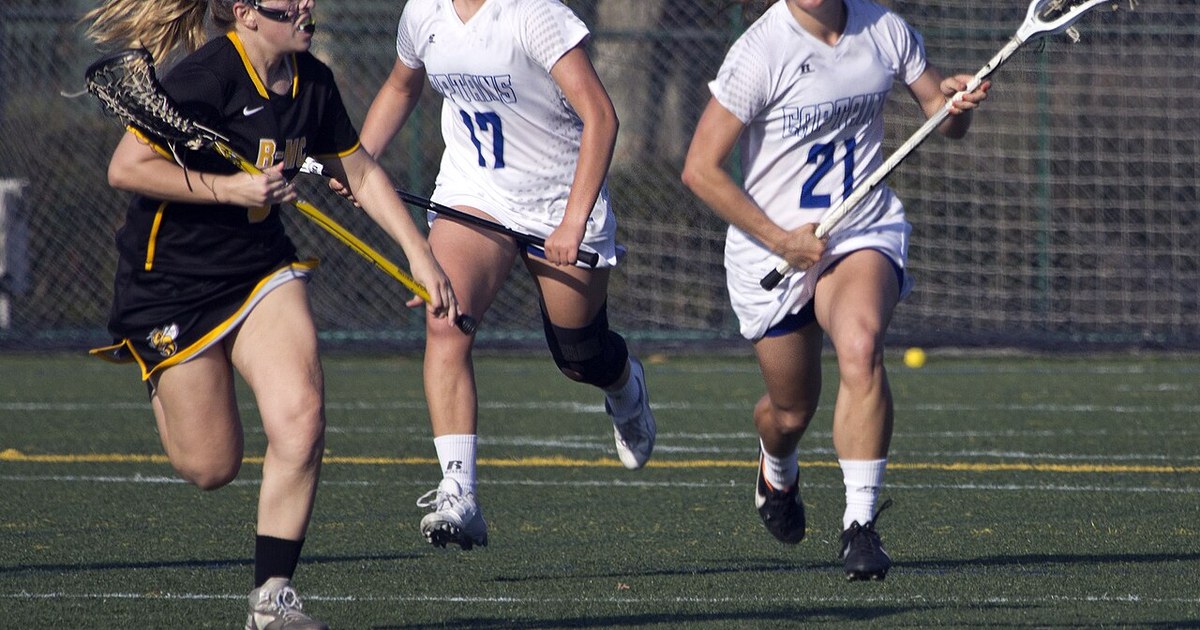
The Draw in Detail
The draw starts each half and restarts play after goals. Two centers stand at the center circle, sticks held up and together, ball placed between the pockets. On the whistle, both players move their sticks up and out in one motion, sending the ball into the air.
Draw technique is a study in detail. Grip, stick angle, wrist speed, and the first step all matter. So does the circle unit. Teammates on the circle read the likely flight, box out with legal body position, and secure the ball with control before cradling away.
At youth levels the draw may be modified, with alternate possession or a modified setup used in the youngest divisions to share restarts. The principle for parents is the same at every age: the draw is a real contest with real technique, not a coin flip.
Modified Checking and Full Checking
Checking means dislodging the ball with a controlled stick check. In youth girls lacrosse, checking is introduced in stages.
What never becomes legal at any level is a wild swing, a check from behind, a check across the body that reaches through the opponent, or any check that enters the sphere.
The Sphere, Explained Plainly
The sphere is an imaginary bubble around a player head, roughly the space a stick may not enter when an opponent is checking or reaching. Picture a clear globe around the head and shoulders. If your stick enters that globe, you have committed a foul, even if you never touched the player.
The sphere explains calls that confuse new fans. A defender can play perfect body position and still foul by reaching high across a carrier face to poke at the stick. An attacker can draw a foul by protecting the ball legally and forcing a defender to reach into the sphere.
Shooting Space, Explained Plainly
Shooting space protects a shooter from a defender standing in her lane.
Defenders avoid the call by marking tightly, by approaching from an angle that does not cross the shooting lane, and by clearing through the area rather than stopping in it. Attackers earn the call by holding a real shooting threat, head up, stick in a shooting position, and lane truly open.
A related rule is the three second rule. A defender may not stay inside the close marked area in front of the goal for more than three seconds without closely marking an attacker.
Common Fouls and Free Positions
Most fouls in the girls game result in a free position restart. The fouled player gets the ball, opponents move to the required distance and position, and play restarts on the whistle.
| Foul | What it looks like | Usual result |
|---|
| Sphere violation | Stick enters the bubble around the head | Free position, card if dangerous |
| Shooting space | Defender illegally occupies the shooting lane | Free position shot chance |
| Three seconds | Defender camps in the close area without marking | Free position |
| Illegal check | Wild, high, across the body, or from behind | Free position, card for danger or repetition |
| Holding, pushing, charging | Body contact outside legal position play | Free position |
| Offside, restraining line | Too many players in a scoring area | Turnover or restart |
Smaller fouls away from the goal often restart quickly with a self start or a set whistle depending on level, which keeps the girls game flowing. Do not judge a foul only by contact. In this game, position fouls are real fouls.
Cards: Green, Yellow, and Red
Cards punish serious, dangerous, or repeated fouls. At the college level, a green card covers delay and similar fouls and removes a player for 1 minute, ending early if the other team scores. A yellow card removes a player for 2 minutes and her team plays short, which changes settled offense and defense at once.
Cards are most often earned for dangerous checks, checks to the head area, reckless play after a warning, and repeated fouling that officials have already addressed. A card is not just a penalty.
The Markings That Carry the Rules
Three markings explain most girls lacrosse calls, and a new fan should learn to see them before anything else. The 8 meter arc is the close scoring area in front of the goal, marked with hash lines where free position shots are set. The 12 meter fan is the larger arc around it, the boundary inside which major fouls tend to produce free positions and outside which play restarts more simply. The restraining lines, set a measured distance from each goal line, limit how many players from each team may be inside the scoring area at once, which keeps twelve player teams from packing both ends of the field.
Add the draw circle at center and the crease circle around each goal, and you own the whole map. Nearly every whistle in a girls game points at one of these lines: a foot over the restraining line, a defender settled inside the arc, a shooter stepping toward the crease.
Anatomy of a Free Position, Step by Step
When a major foul happens inside the fan, the fouled player takes the ball at the nearest hash mark on the 8 meter arc. The player who fouled moves a set distance behind her. Every other defender inside the arc must clear out of the shooting lane and stand a set distance away, and the nearest defender may mark her from the side. On the whistle the shooter may run, shoot, or pass, and everyone else may move.
Watch the shooter first step. Experienced players take one hard step toward goal to freeze the marking defender, then decide: shoot if the lane stayed open, feed if a helper slid. The free position is a designed scoring chance, which is why defenders treat fouls inside the arc as the most expensive mistakes in the girls game.
The Draw Circle Unit: Five Players, Not Two
New fans watch the two centers and miss the four teammates standing on the circle. Those players are not decoration. On the whistle they box out with legal body position, read the flight the centers practiced, and secure the ball before it becomes a fifty fifty scrum. Teams assign circle spots by skill: the best ground ball player on the side the draw favors, a fast midfielder behind for the over the top flight, and a safe outlet behind the play for the messy ones.
Coaches chart draw wins as a unit stat for this reason. A center with a perfect snap loses draws if her circle gives up position, and an average center wins plenty behind a circle that seals its spots early.
One Defensive Possession, Read in Order
The ball swings to a strong dodger at the top of the fan. Her defender shades her toward her weak hand and stays goal side, stick up in the passing lane. The dodger drives, and the adjacent helper shows two steps toward her, close enough to help, far enough to avoid standing in the shooting lane. The dodger pulls the ball back instead of forcing the shot, and the helper recovers. A cutter flashes through the arc; the back defender marks her through, calls her out to the next defender, and resets inside three seconds. The ball goes behind the goal, the defense turns its head as one, and the possession ends with an outside shot the goalie sees all the way. No foul, no free position, no card: that is what the rules on this page look like when a defense plays them well for thirty seconds.
The Restraining Line Count During Transition
One count runs quietly under every girls game: the number of players each team may have inside the restraining line area at each end. During a fast break the count is the rule most likely to whistle a goal back, because an eager seventh attacker crossing the line early is offside even if she never touches the ball. Smart midfielders learn to brake at the line until a teammate clears out, and coaches drill the brake the same way they drill the break itself.
Frequently Asked Questions
What is a free position in girls lacrosse?
A free position is a restart where the fouled player holds the ball at a set spot while opponents are placed at a required distance. Near the goal, it becomes a direct scoring chance with a cleared lane. Away from the goal, it restarts flow with an advantage to the fouled team.
Why do girls lacrosse players wear goggles instead of helmets?
The girls game is built on restricted body contact and strict stick control, with the sphere and checking rules protecting the head area. Field players therefore wear approved goggles and a mouthguard, while the goalie wears a helmet and full goalie protection. The equipment matches the contact model of the game.
What does modified checking mean for a youth player?
It means checking is limited by age and level, often to a controlled check in a lower, safer zone or removed entirely for the youngest players, so beginners learn footwork and positioning first. Ask your coach which checking level your division uses, because it changes how defense should be played and coached.
What happens after a yellow card in girls lacrosse?
The carded player leaves the field for a set penalty period, two minutes at the college level, and her team plays one player short until the time runs out or, at some levels, the other team scores. A second yellow card in the same game means ejection, so a carded player returns to the field playing feet first defense with her stick held low and legal.
Why is there no body checking in the girls game?
The girls game was designed and has been kept as a stick skill and positioning game, with contact limited to legal position play and controlled stick checks. The protective rules, the sphere, shooting space, and the checking limits, all exist to keep that design intact, and the equipment follows from it: goggles and a mouthguard for field players instead of helmets and pads.