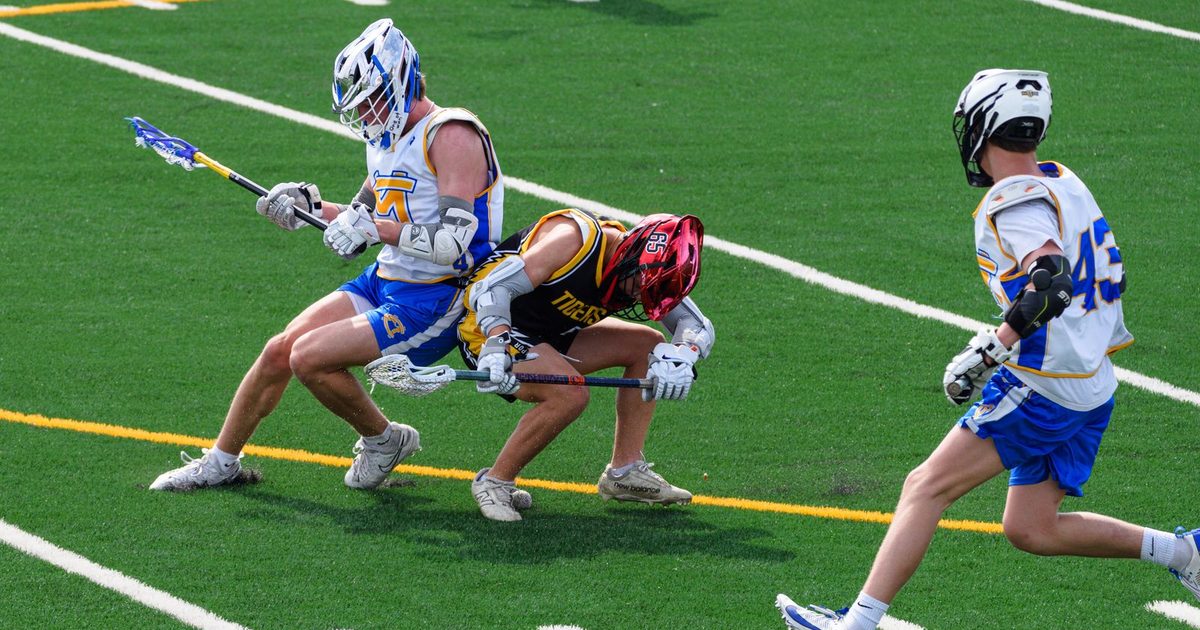
The 12 Player Setup
At the full field level, each team plays with 12 players: 1 goalie, 4 defenders, 5 midfielders including the center, and 2 low attackers, with midfielders joining the attack in settled offense.
| Role | Count | First job to learn |
|---|
| Goalie | 1 | Positioning in the crease, clear passes |
| Defender | 4 | Mark a player, stay goal side, communicate |
| Midfielder and center | 5 | Play both ends, take draws if you are the center |
| Low attacker | 2 | Cut, feed, and finish around the crease |
Youth games often use fewer players and a smaller field. That is a teaching choice. More touches and less standing around build better players.
The Draw Starts Everything
Play starts and restarts after goals with the draw at center. You and your opponent stand facing each other, sticks held up, with the ball placed between the pockets. On the whistle, you drive your stick up and out to send the ball into the air, ideally to yourself on the run or to a teammate circling in from the edge of the center circle.
Draw work rewards practice. Work on your wrist snap, your first step, and boxing out legally with position, not contact. Midfielders on the circle need a plan too: read the flight, time your run, and secure the ball with two hands on the stick before you cradle away from pressure. Teams that control the draw control the tempo of the whole game.
How Play Flows When Your Team Has the Ball
Carry the ball while cradling to keep it in the shallower pocket used in the girls game. That pocket is a defining feature.
Pass quickly, cut after you pass, and look to feed teammates cutting through the middle. In settled offense, spacing matters. Stay wide enough to stretch the defense, time cuts so you arrive as the ball does, and shoot when you have a clear lane that respects shooting space rules for defenders.
When your team loses the ball, redefend at once. Mark up, protect the middle, and slow the fast break before it becomes a numbers advantage.
Checking Limits and Staying Legal
Checking in girls lacrosse means a controlled stick check to dislodge the ball from an opponent stick. A legal check is short, quick, and directed at the head of the opponent stick, away from the body and away from the head. There is a protected bubble around each player head called the sphere. Your stick may not enter the sphere of an opponent.
Body contact is limited. You play defense mainly with footwork, body position, and stick position. You may not push, hold, or charge. At younger youth levels, checking is modified further or introduced in stages under USA Lacrosse age based rules, so ask your coach what level of checking your division uses this season.
Two other concepts shape defense near the goal. Shooting space means a defender cannot stand in the clear lane between a shooter and the goal unless marking that shooter closely. The three second rule means a defender cannot camp inside the close area in front of the goal without marking an attacker. Both rules keep the area in front of the goalie open and safe.
Protective Gear You Actually Wear
Field players wear goggles for eye protection and a mouthguard. That combination surprises families coming from the boys game, but it fits a game built around restricted contact and strict stick control. The goalie wears more: a helmet, throat protection, chest protection, and gloves, plus a goalie stick with a larger head.
Your stick matters too. A girls field stick has a narrower head and a shallower legal pocket than a boys stick. Stringing and pocket depth are checked by officials, and an illegal pocket can remove the stick from the game. Buy a stick made for the girls game, keep the pocket legal, and break it in with wall ball.
Key Differences From the Boys Game
The boys game plays 10 against 10 with a faceoff, helmets and pads, deeper pockets, and body checking under limits. The girls game plays 12 against 12 with a draw, goggles, shallower pockets, and stick checking only. Restarts, fouls, and cards also differ.
Your First Four Weeks, Week by Week
Week one: grip, cradle, and scoop. Hold the stick with the top hand near the head for control, cradle at a walk until the ball stays quiet in the pocket, and scoop twenty ground balls a day with the top hand slid low and the back hand guiding. Week two: partner passing. Twenty throws and catches at ten yards, then the same set moving sideways, then the first weak hand set at half the reps. Week three: the draw and the circle. Practice the wrist snap motion without a ball, then with a partner feeding soft draws, and learn where circle players stand and why boxing out is position, not contact. Week four: small sided games. Three against three teaches spacing, cutting, and redefending faster than any drill line, and it shows a new player exactly which skill to practice next.
Scoring Your First Goal: How Chances Are Built
New players imagine goals come from running past everyone. Real youth goals usually come from a sequence: a pass behind the goal, a cutter arriving as the feeder turns, and a shot taken before the goalie sets. The second most common source is the free position restart after a foul in the arc. The third is transition, a save followed by a quick clear and a shot before the defense organizes. A beginner who learns to cut on time, to stand correctly for a free position, and to sprint the field after a save has learned where goals actually live in this game.
Mistakes Every Beginner Makes and the One Line Fix
Carrying the stick flat like a tray invites checks; keep the stick vertical and beside the body. Watching the ball during a cut blinds the cutter; turn the head and show the stick as a target early. Standing after a pass freezes the offense; cut or clear out on every pass. Reaching on defense loses balance; move the feet first and let the stick check come last. Scooping with a stiff top hand pops the ball out; slide the hand down and let the scoop slide under the ball. Each fix fits in one sentence because beginners improve on cues they can remember at full speed.
Understanding the Whistles in Your First Game
Three whistles confuse new girls players more than any others. The first is the shooting space call against a defender who drifted into the lane between the shooter and the goal without marking her; the restart hands the attacker a free position, and the lesson is that defenders guard players, not space. The second is the three second call against a defender who camped inside the arc area; the lesson is that close defense must keep moving or keep a mark. The third is the check to the head area, where a stick entered the sphere around a player head; the lesson is that checks live low, on the stick, and under control. A beginner who learns those three whistles in her first month understands the defensive rulebook better than many second year players, because those calls carry the whole philosophy of the girls game inside them: skill and position first, protection always.
Game Day: What Actually Happens, Hour by Hour
Arrive early enough to warm up without rushing, usually thirty to forty five minutes before the first draw at youth level. The first block belongs to the body: jogging, dynamic movement, and easy cradling while the hands wake up. The second block belongs to the hands: partner passing that grows from stationary to moving, with weak hand reps included before anyone asks. The third block belongs to the team: draw work for the circle unit, a few settled possessions walked through, and free position practice for the players most likely to take them. In the final minutes the goalie takes shots at game speed while field players keep sticks moving. When the draw comes, a prepared player has already touched every skill the first quarter will ask for, and the nerves that remain are the useful kind.
Frequently Asked Questions
Do girls wear helmets in lacrosse?
Field players wear goggles, not helmets, in the standard girls game, while the goalie wears a helmet. Some leagues and players use optional headgear where allowed, but goggles and a mouthguard are the required base for field players. Follow your league rule for your level.
Is girls lacrosse hard to learn for a beginner?
The basics come quickly: cradling, passing, catching, and ground balls in the first weeks. The draw, legal checking, and shooting space take longer, because they are unique to this game. Wall ball and small sided games close the gap fast.
What position should a new player try first?
Midfield is the best teacher, because you play offense, defense, and transition in one role. Players who love scoring gravitate to attack, patient readers of the game fit defense, and a fearless communicator should try goalie.
How long are girls lacrosse games?
Youth girls games use short periods with a running clock and often finish within an hour. High school and college games run longer and, depending on the governing body and season, use halves or quarters with more clock stoppages. Your league sheet states the format for your level before the season starts.
Can girls check in lacrosse?
Yes, with strict limits. A legal check is a short, controlled tap to the head of an opponent stick, directed away from the body, never into the protected sphere around the head, and never a swing. Youth levels modify checking further or delay it by age group. Body checking is not part of the girls game at any level.