One Sport, Two Position Maps
Lacrosse positions look simple on a roster and confusing live, because players move so much in transition. The trick is to learn home areas. In settled play, every position returns to a home zone, does a clear job there, and only leaves that zone for a reason.
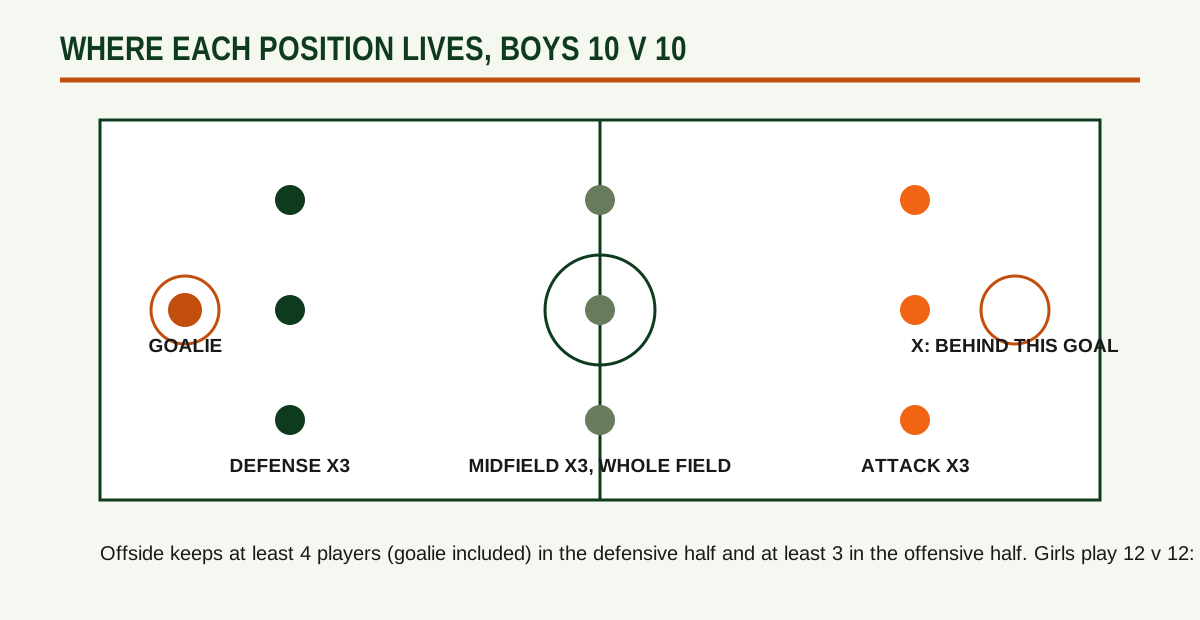
Underneath the movement sit two fixed structures. The boys and mens game fields 10 players per side: three attack, three midfield, three defense, and one goalie. The girls and womens game fields 12: four attack, three midfield, four defense, and one goalie. The offside rule welds those structures to the field. Boys teams must keep at least four players, goalie included, in the defensive half and at least three in the offensive half. Girls teams play under a restraining line system that caps how many players may crowd either end. Positions are therefore not suggestions. They are the shape the rules force on the game, and this page maps every role in both games, with stick lengths and counts compiled from the USA Lacrosse equipment guide and youth rules, credited where they appear.
Every Position at a Glance
Credit: compiled by OYLAX from the USA Lacrosse Equipment Guide for the 2026 seasons and the USA Lacrosse youth rules. Stick lengths are overall lengths. Girls field players share one stick range at every position, so the girls columns show the structure of the 12 player game.
| Position | Boys count | Boys stick | Girls count | Girls stick | Home zone | Core skills |
|---|---|---|---|---|---|---|
| Goalie | 1 | 40 to 72 inches, head up to 12 inches wide | 1 | 35.5 to 52 inches, head up to 12 inches wide | The crease and the front of the goal | Save technique, arc positioning, clearing throws, defensive communication |
| Defense | 3 | Long pole, 52 to 72 inches | 4 | Field stick, 35.5 to 43.25 inches | Defensive half, around the crease and the box | Footwork, body position, poke and lift checks, slide timing |
| Midfield | 3 | Short stick, 40 to 42 inches | 3 | Field stick, 35.5 to 43.25 inches | The whole field, both halves | Transition speed, two way stamina, ground balls, clearing and riding |
| Attack | 3 | Short stick, 40 to 42 inches | 4 | Field stick, 35.5 to 43.25 inches | Offensive half, around the opposing goal | Dodging, feeding, finishing, riding on lost possession |
| Long stick midfielder | Part of the 3 midfielders | Long pole, 52 to 72 inches | Not a girls role | Not applicable | Defensive half and the wing on faceoffs | On ball defense, ground balls in traffic, transition clearing |
| Faceoff specialist (FOGO) | Part of the 3 midfielders | Short stick, flexible faceoff head | Not a girls role | Not applicable | The center X, then the bench | Clamp technique, exit speed, wing communication |
| Short stick defensive midfielder | Part of the 3 midfielders | Short stick, 40 to 42 inches | Not a girls role | Not applicable | Defensive half | Approach angles, containing dodgers, clearing under pressure |
| Draw specialist | Not a boys role | Not applicable | Usually one of the 3 midfielders | Field stick, 35.5 to 43.25 inches | The center circle | Draw placement, wrist snap, self draws and circle play |
Attack: The Finishers and Feeders
Attack players live in the offensive half. Their working map is small and crowded: the crease front, both wings, and the area behind the goal that everyone calls X. From X, the quarterback attacker runs the settled offense, feeding cutters through the middle and dodging to either side of the cage when the defense watches the ball too long. The crease attacker plays closest to the goal, timing cuts into the seams of the defensive shell and finishing feeds in traffic. The third attacker balances the field on the opposite wing, ready for the skip pass that beats a rotating defense.
Attack is judged on decisions as much as hands. A dodge that draws a slide creates a shot for someone else. A dodge into a set double team creates a turnover and a lecture. The best youth attackers learn to count defenders out loud during practice until reading the shell becomes reflex.
Midfield: The Engine Room
Midfielders are the only players whose home zone is the entire field. They defend their own half, clear the ball through the middle of the field, join the attack, and then sprint back when possession flips. A first midfield line at the youth level can run several miles in a game, most of it at near full speed, which is why coaches rotate midfield lines in shifts like hockey and why conditioning separates good middies from willing ones.
Inside the midfield group live the specialists. The long stick midfielder carries the fourth long pole the rules allow, taking the toughest opposing midfielder as his defensive assignment and hunting ground balls on the faceoff wing. The short stick defensive midfielder guards with a short stick, a matchup offenses attack on purpose, and earns his place with approach angles, discipline, and clearing under a ride. The faceoff specialist may play only seconds at a time and still decide the game, because every clamp he wins is a possession his attack did not have to earn back.
Defense: The Shell Around the Crease
Close defenders guard the attack, protect the crease, and run the slide system that answers every dodge. The crease defender owns the middle and usually makes the first slide, arriving with his body as the dodger turns toward the goal. The wing defenders balance on ball defense against containment, and all three defenders clear the ball after turnovers, which means a defender who cannot throw on the run is a turnover waiting for its moment.
Boys defenders do this work with long poles, using reach to poke at the bottom hand, lift the stick on shots, and intercept passes thrown too close to the crease. Girls defenders do the same jobs with a field stick and no long pole, so their craft tilts toward footwork, hip position, and stick placement in the passing lanes. Watch a good girls defender and you will see her stick live in the lane between feeder and cutter more often than it chases the ball carrier stick.
Goalie: The Position That Talks
The goalie home zone is the crease, a circle the attack may not enter. From there the goalie stops shots, calls ball position and slides for the whole defense, and starts the clear. The goalie is the only player allowed to touch the ball with a hand, inside the crease and only to block it, and the only player working against a possession clock in the crease: four seconds in the boys game, ten seconds in the girls game. Families new to the sport should read the dedicated goalie guide on this site for the full picture of stance, arc play, and equipment standards.
The Girls Structure: Twelve Players, Different Geometry
Adding two players changes more than the arithmetic. With four attack and four defense, the girls game settles into a wider shell, and the restraining line keeps seven attackers at most in the offensive end, which preserves space to dodge. The traditional girls position names, first home, second home, third home, point, and cover point, still appear in older coaching material, mapping roughly onto attack, midfield link players, and defense. Modern rosters mostly use attack, midfield, defense, and goalie, plus the draw specialist, who is tracked as her own category because draw control decides so many girls games.
The girls midfielder is the closest cousin of the boys two way middie, with one addition: she often takes the draw or plays the circle, so her position group owns restarts as well as transition.