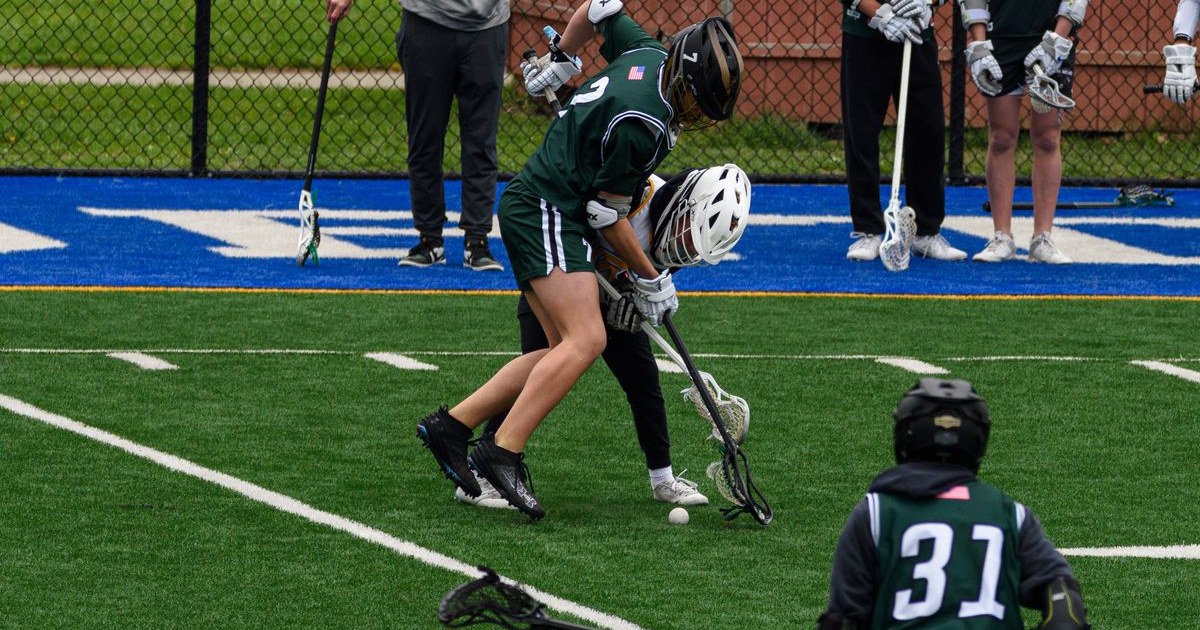
The Whole Game in One Minute
Lacrosse is a team game played with a stick that has a net pocket on the end. Your team tries to throw a small ball into the other team goal, and the other team tries to stop you and score in yours. The goal is 6 feet by 6 feet, about as tall as a grown up. You can run with the ball in your stick, pass it to teammates, and pick it up off the ground. That scooping skill matters more than almost anything else at your age.
You do not need to learn the whole rulebook. You need a handful of rules to play your first games happily and safely. This page is that handful, written so a player and a parent can read it together.
The Five Rules a Young Player Needs First
Rule one: stay out of the crease. The crease is the big circle painted around the goal. Only the goalie can stand inside it. If you are attacking and your foot steps in the circle, the whistle blows and the other team gets the ball. Give the goalie room.
Rule two: stay on your side count. Your team has to keep a certain number of players on each half of the field. Your coach will shout reminders. If too many players cross the middle line chasing the ball, that is offside and the whistle blows.
Rule three: keep your stick under control. You may check the stick of the player with the ball in the older kids game, with control, but you never swing your stick wildly, hit anyone in the head, or push from behind. At the youngest levels, there is little or no checking at all. Your job is to play the ball, not the person.
Rule four: wear all your gear, every time. Boys wear a helmet, mouthguard, shoulder pads, arm pads, and gloves. Girls wear goggles and a mouthguard. If your mouthguard is in your hand instead of your mouth, you cannot play until it is fixed.
Rule five: play the whistle. When you hear a whistle, stop, look at the official, and listen. Sometimes your team keeps the ball and sometimes it changes. Stopping fast and listening is a skill coaches love.
Words You Will Hear: A Simple Glossary
| Word | What it means |
|---|---|
| Cradling | Rocking the stick gently so the ball stays in the pocket while you run |
| Scooping | Rolling the stick head along the ground to pick up the ball |
| Ground ball | A loose ball on the ground that anyone can scoop |
| Crease | The circle around the goal where only the goalie belongs |
| Faceoff or draw | How play starts at the center of the field |
| Offside | Too many players from one team on one half of the field |
| Clear | Moving the ball from your defensive end up the field after a save or a stop |
| Ride | Trying to win the ball back while the other team clears |
| Man down | Playing with one fewer player because a teammate has a penalty |
| The net part of the stick where the ball sits |
What the Whistle Usually Means
One short whistle often starts or restarts play. A whistle during play means something needs fixing. The most common reasons in kids games are simple: someone stepped in the crease, too many players crossed the middle, the ball went out of bounds, a player dropped or lost required gear, or a stick or a push was not safe. In kids lacrosse the officials also blow the whistle to teach. They may explain the call to the player right there on the field. That is normal and helpful, not a sign your child did something terrible.
If the other team gets the ball after the whistle, the usual reason is that the foul gave them the restart. If your team keeps it, your team was the one fouled or the restart belongs to you. Watching who restarts with the ball answers most parent questions from the sideline.
Out of Bounds and Ground Balls
When a pass goes out of bounds, the other team usually gets the ball. Shots work differently. When a shot misses and goes out behind the goal, the team with the player closest to the ball where it crossed the line usually keeps it. That is why players race to back up every shot, and why coaches yell about it constantly.
Loose balls belong to whoever scoops them cleanly. Run through the scoop, keep your stick low, and protect the ball by bringing the stick up to your body as you run out of the crowd.
A Note for Parents
Kids rules are modified on purpose. Fields are smaller, teams are smaller, games are shorter, and checking is limited so children learn skills before force enters the game. Cheer for scoops, good passes, and brave goalie play. Let the officials teach with their whistles. The child who loves the first season is the one still playing in the fifth.
A First Game, Told Whistle by Whistle
The game starts with a faceoff or a draw at the center, depending on whether you are watching the boys game or the girls game. The ball pops loose, three players chase it, and somebody scoops it while running. That scoop is the first skill of lacrosse, and kids should hear it praised every time. The player with the ball runs, looks for a teammate showing a stick as a target, and passes. If the pass drops, nobody is in trouble. The nearest players from both teams simply race to scoop it again, because a ground ball is a fresh contest, not a mistake.
When the ball rolls out of bounds after a shot, the team with a player standing closest to it keeps the ball. Kids learn this rule fastest of all, because it rewards the simple habit of sprinting toward the end line after every shot. When a player steps into the circle around the goal, the whistle blows and the other team gets the ball. When the goalie catches a shot, everyone on her team yells a happy word and runs to open spots so she can pass it out. That is most of a first game, and a child who understands those five moments can follow the rest as it comes.