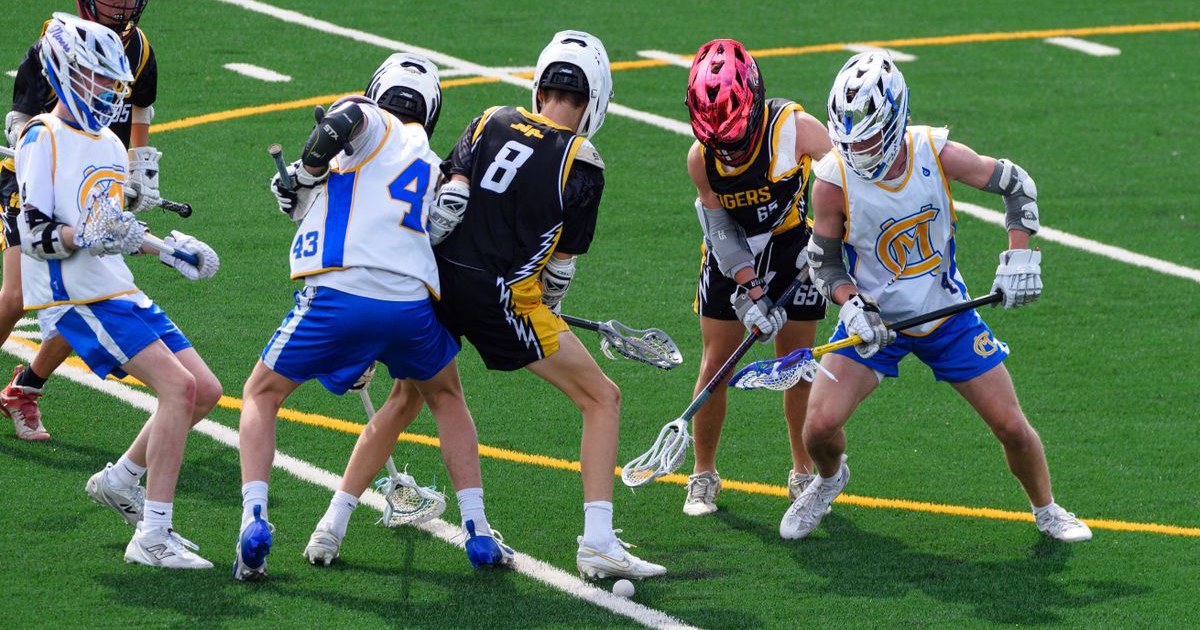
Mens Game: Personal Fouls
Personal fouls are the serious family.
| Personal foul | What happened | Typical time |
|---|
| Slashing | Wild or forceful stick swing to body or head | 1 to 3 minutes |
| Tripping | Stick or body trips an opponent | 1 to 3 minutes |
| Illegal body check | To the head, from behind, late, or below the waist | 1 to 3 minutes |
| Cross checking | Shaft between the hands driven into an opponent | 1 to 3 minutes |
| Unsportsmanlike conduct | Arguing, taunting, or dangerous repeat behavior | 1 to 3 minutes, ejection possible |
| Illegal equipment or stick | Stick or gear outside the rules when classified as personal | Varies by level |
Times vary by level and official judgment, so treat the table as the common pattern, not a promise for a specific game. What does not vary is the consequence: your team defends a player short against an offense that has practiced exactly this situation.
Mens Game: Technical Fouls
Technical fouls are the procedural and possession family. They include holding, pushing, interference, offside, crease violations, illegal screening, warding off with the free arm, and procedural errors such as illegal substitution or delay. The standard result is 30 seconds of penalty time when the fouled team had possession of the ball, and a change of possession when it did not.
A useful sideline test: if the foul was about how a player hit or swung, think personal. If it was about where a player stood, how he held, or what procedure his team broke, think technical. Coaches can fix technical fouls with teaching in one practice. Personal fouls require changing habits, which is harder and more valuable.
Flags and slow whistles connect the two families. When an official sees a foul against the team with the ball, he may throw a flag and let play continue until the offense scores, loses possession, or the play ends, so the fouled team does not lose a scoring chance because of the whistle.
Girls Game: Fouls, Free Positions, and Cards
The girls game does not sort fouls into the mens personal and technical boxes. It uses free positions for most fouls and cards for serious ones. Minor fouls, such as certain procedural and positioning errors away from the scoring area, restart play with an advantage to the fouled team.
At the college level, a green card covers delay and similar fouls and sends a player off for 1 minute, with the penalty ending early if the other team scores. A yellow card sends a player off for 2 minutes and her team plays short. A red card ends that player's game and carries team and possible league consequences. Because the girls game has no penalty box culture in the mens sense, a card is a major event that coaches and officials treat with full seriousness.
For a detailed girls treatment of the sphere, shooting space, and checking levels, read the girls rules guide on this site alongside this penalty overview. The two articles are designed to work together without repeating each other.
Man Up and Man Down Play
When a mens player serves time or a girls player serves a card, the teams play man up and man down, also called extra man offense and man down defense, or power play and penalty kill in box lacrosse.
The man up offense spreads the field, moves the ball quickly around the outside, and hunts the two situations a short defense cannot cover: a skip pass across the formation and a cutter behind a rotating defender.
Time management is part of the skill. A man down team that wins a ground ball may slow its clear to burn penalty time. A man up team that rushes a bad shot gives the ball and the kill away for free.
Box Lacrosse Penalties in Brief
Box penalties send a player to the box for minor or major times by level, and power plays score often because the floor is small and one player is a large share of a six player team. Boarding, head contact, and fighting are punished heavily.
How Players Stay Out of Trouble
The cleanest players share three habits. They play defense with their feet first, so they are rarely late or behind. They keep stick checks short and aimed at the stick or gloves, so slashing never enters the conversation.
The Thirty Second World: Technical Fouls Up Close
Technical fouls look small on a scoresheet and loom large on a field. Holding, pushing, interference, offside, illegal screens, and crease violations share one trait: none of them involves trying to hurt anyone, and all of them hand momentum to the other team. The ruling splits on possession. If the fouled team had the ball, the fouler serves thirty seconds. If the ball was loose or the defense fouled, the whistle simply awards possession. Coaches track technical fouls separately in film review because they are the fixable kind: a midfielder who crosses early on three straight clears has a substitution timing problem, not an aggression problem, and timing problems get solved in one practice.
Anatomy of a Man Up Possession
When a personal foul sends a player to the box, the game changes shape for the length of the sentence. The man up offense spreads wider than a settled offense, moves the ball quickly around the perimeter, and hunts the two against one that the missing defender guarantees somewhere. The man down defense shrinks toward the crease, concedes the farthest and lowest percentage shooter, and talks constantly, because one silent rotation is the goal. Watch the last fifteen seconds of a penalty for the real drama: the penalized player sprints back in as his time expires, and offenses time their best look for exactly that moment of confusion, while defenses drill the call that tells everyone the box is about to empty.
Ejections, Misconduct, and the Fouls That Follow a Player
Above the ordinary ladder sit the fouls with paperwork. Fighting, deliberately dangerous play, flagrant misconduct, and repeated abuse of officials draw ejections, and in school lacrosse an ejection usually carries a suspension into the following game under state rules. A player who earns a reputation for borderline hits also discovers the quiet penalty: officials watch known players more closely, and the check that went uncalled in September gets flagged in April. The cheapest career advice in lacrosse is to be boring to officiate. Players whose names officials never learn play more minutes, take more faceoffs and draws, and never cost their team a man down minute in a playoff game.
Girls Game Cards, Counted Carefully
In the girls game the card system does the work that penalty minutes do in the boys game, and it escalates by design. A green card handles delay and minor misconduct at the college level with a short removal. A yellow card removes a player for a timed period while her team plays short, and two yellows in one game end her day. A red card is ejection, for the dangerous or flagrant act itself. Captains and coaches track the card count the way boys coaches track the box, because a star defender carrying a yellow defends the rest of the game with her stick down and her feet perfect, or she does not finish it.
The Penalty Killers: Roles on a Short Handed Unit
A man down or card down unit is not simply the regular defense with someone missing. It has named jobs. The crease defender becomes a pure goal protector who concedes every outside pass. The two low defenders split the inside and call switches instead of chasing cutters. The high defender pressures the ball just enough to rush the feed without opening the middle. And one named player owns the rebound and the clear, because a stop that cannot be cleared is only a delay. Units that rehearse these four jobs give up shots during penalties; units that improvise give up goals. The difference shows up in the standings by midseason, in the column nobody traces back to a thirty second foul in the second game of the year.
Watching the Box: A Fan Habit Worth Learning
Sit where you can see the penalty box or the card table for one game and the penalty system stops being abstract. You will see the timekeeper signal the last ten seconds, the penalized player kneel ready at the edge, and the substitute count that follows the release. You will also see how often the next foul belongs to the team that just finished celebrating a kill. Penalties in lacrosse are a rhythm as much as a punishment, and the box is where the rhythm is kept.
Frequently Asked Questions
What does releasable mean for a penalty?
A releasable penalty ends early if the other team scores during the penalty time. A non releasable penalty is served in full regardless of goals scored. Serious personal fouls are more likely to be non releasable. The exact classification depends on the foul and the level.
Can a goalie serve a penalty?
In the mens game, a goalie who commits a time serving foul is typically replaced in the goal by a teammate or a backup while the penalty is served under the procedures for that level, because a team cannot play without a properly equipped goalie. Coaches plan for this emergency before it happens.
Do penalties carry over between periods?
Yes. Penalty time that remains when a period ends carries into the next period, and a player who is serving time at the horn starts the next period in the box or off the field under card rules until the time is complete.
What is the most common penalty in lacrosse?
At the youth and high school levels, slashing and illegal body checks lead the personal foul list in the boys game, while holding, offside, and pushing fill the technical column. In the girls game, illegal checks and shooting space or three second violations inside the arc produce the most free positions and cards.
Do penalty minutes add up across a game in school lacrosse?
Yes. Many school rule sets include a disqualification threshold based on total personal foul minutes or total fouls, so a player who keeps collecting short penalties can still be removed for the accumulation. The exact threshold comes from the NFHS book and your state adoption, and coaches track it on the bench during the game.