Lacrosse is a field sport where two teams move a small rubber ball with sticks and score by shooting it into the opponent goal. Each goal counts one point, and the ball must pass completely through the plane of the 6 foot by 6 foot goal frame. The goal sits inside a circular crease. Attacking players may not step into the crease, and only the goalie lives there on defense.
The two versions of field lacrosse played in the United States, the boys game and the girls game, share that skeleton and differ in almost every joint. Boys teams field 10 players: three attack, three midfield, three defense, and one goalie. Girls teams field 12: four attack, three midfield, four defense, and one goalie. Boys play permits body checking under limits that grow with age. Girls play prohibits body to body contact and controls stick checking instead. USA Lacrosse publishes the youth rules for both games, and this page follows its framework, crediting USA Lacrosse wherever its data appears.
The Field and Its Lines
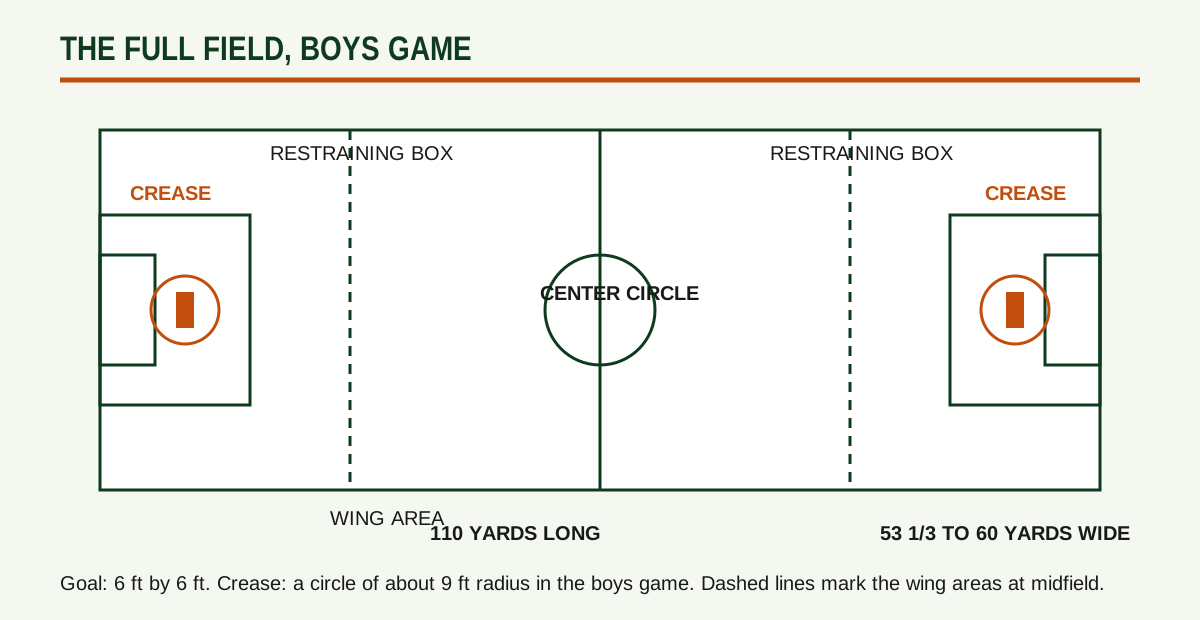
At full size, the boys game is played on a field 110 yards long and 53 1/3 to 60 yards wide, per the USA Lacrosse boys youth rules. A midfield line splits the field in half, with a center circle where faceoffs happen. Near each goal sits a restraining box, the area that organizes settled offense and defense, and around each goal a crease circle that belongs to the goalie and the defense.
Diagram of a full lacrosse field with the crease, restraining boxes, wing areas, and dimensions marked
Younger age groups shrink all of this on purpose. Small sided games on cross field or three quarter field setups give every child more touches, more decisions, and more goals than a full field game with twice the running and half the involvement. The format table further down this page shows exactly how the game scales.
How Play Starts: Faceoffs and Draws
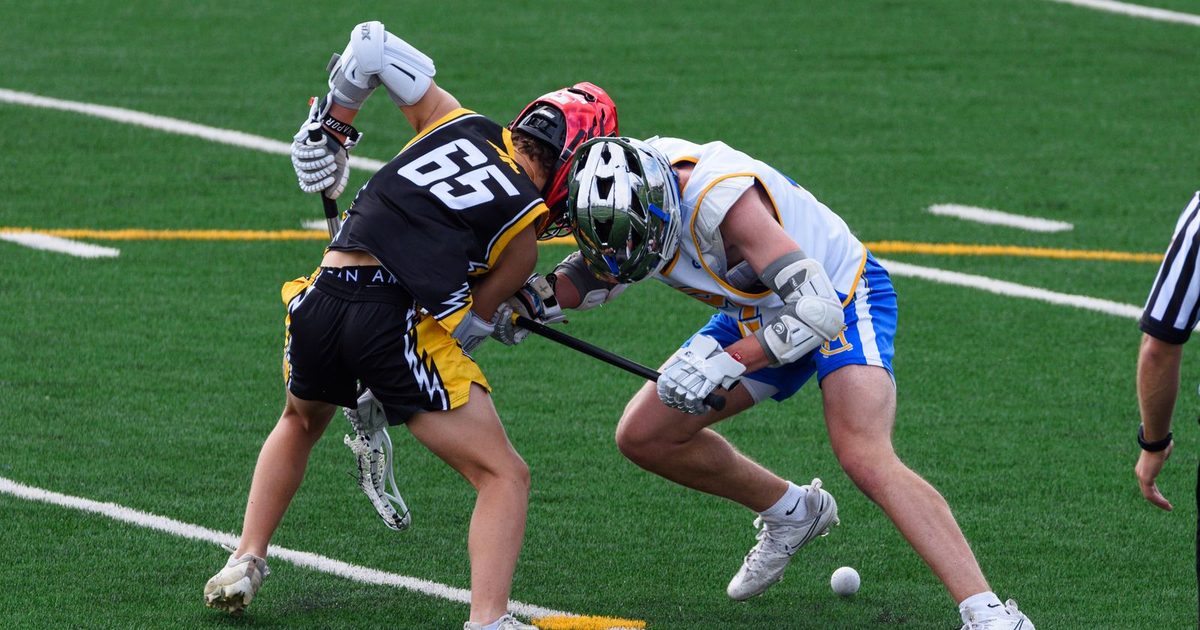
In the boys game, every quarter and every restart after a goal begins with a faceoff. Two specialists crouch over the ball at midfield, backs to their own goals, sticks parallel to the ground. On the whistle they clamp, rake, or flip the ball to themselves or to a wing midfielder sprinting in from the wing area. A dominant faceoff player hands his team possession after possession, which is why the role has its own specialists.
The girls game restarts with a draw. Two players stand in the center circle holding their sticks at hip height with the ball pressed between the backs of the pockets. On the whistle each pulls up and back, sending the ball into the air where midfielders and circle players contest it. Draw control is a tracked specialty in the girls game, and teams build set plays around a trusted draw taker.
Test Yourself as You Read
Interactive tool
Rules Quiz: Check What You Just Read
Answer each question for instant feedback. Every question is drawn from the verified rules data compiled on this page, sourced from USA Lacrosse.
Score: 0 of 12 (0 answered)
1. How many players does a boys field lacrosse team put on the field at full size?
2. How many players does a girls field lacrosse team put on the field at full size?
3. What are the dimensions of a full size boys field?
4. How long is a regulation boys short stick for attack and midfield from 12U up?
5. How many long crosses may a boys team have on the field at one time?
6. How long may a boys goalie keep the ball inside the crease before clearing it?
7. What size is a lacrosse goal?
8. In the girls game at 12U and 14U, how is pocket depth judged?
9. Which restart begins each quarter and follows each goal in the boys game?
10. Which piece of goalie equipment must meet the NOCSAE ND200 standard?
11. At boys 10U, which stick is legal for a defender?
12. What happens when a shot misses the goal and goes out of bounds?
Possession, Passing, and the Ball in the Stick
Except for the goalie inside the crease, no player may touch the ball with a hand. Everything happens through the stick: scooping ground balls, catching, cradling to protect the ball while running, passing, and shooting. A player may carry the ball as long as they like, which is why defense is about angles and checks rather than a shot clock at the youth level.
When a pass or a carry sends the ball out of bounds, possession goes to the team that did not touch it last, the familiar rule from most sports. Shots are the famous exception. When a shot misses and crosses the boundary, the ball belongs to the team with a player closest to the ball at the moment it went out. That single rule explains the strangest sight for new fans: attackers sprinting to back up their own missed shots behind the goal, because backing up the shot is worth a whole extra possession.
Offside: The Rule That Keeps Positions Honest
Positions in lacrosse are enforced by the offside rule. In the boys game a team must keep at least four players, counting the goalie, in its defensive half, and at least three in its offensive half. Under USA Lacrosse boys youth rules a team is offside with more than six players in its offensive half or more than seven in its defensive half. Attack players therefore cannot chase the ball into the defensive end, and defenders cannot join a fast break in unlimited numbers. Midfielders are the only players free to cross midfield both ways, which is why they run more than anyone on the roster.
The Crease and the Goalie
The crease is the goalie protected circle. An attacking player who steps into it commits a violation: the whistle blows, the ball goes to the defense, and a goal scored while the shooter or a teammate stood in the crease is wiped off. Defensive players may pass through their own crease, and the goalie may leave it, but leaving means playing by field player rules.
Inside the crease the goalie owns special privileges. The goalie is the only player who may touch the ball with a hand, and even then only to block it, never to pick it up or hold it. In the boys game, a goalie with possession inside the crease has four seconds to pass the ball out or carry it out. In the girls game the goalkeeper has ten seconds to clear the crease. Those counts are why a save is immediately followed by a loud, fast clearing pass up the sideline.
Contact, Checks, and Fouls
Boys lacrosse phases contact in by age under the USA Lacrosse youth rules. At 6U and 8U there is no body checking at all, only limited stick checks such as the lift and the poke below the shoulders. At 10U body checking remains off the table. At 12U it arrives with restrictions, and at 14U it is legal from the front or side, between the shoulders and the waist, with take out checks that endanger a player still banned. At every level, a legal check targets the player with the ball or close to a loose ball, and hits to the head, hits from behind, and hits on a defenseless player are fouls.
Boys fouls split into two families. Personal fouls such as slashing, tripping, and illegal body checks send the player to the penalty box for one to three minutes, and his team plays a man down. Technical fouls such as offside, crease violations, and holding cost possession or a thirty second penalty depending on who held the ball.
Girls lacrosse replaces the body check with the sphere and the controlled stick check. A defender may check the opponent stick with a controlled motion, but the stick may not enter the imaginary sphere around the ball carrier head, and dangerous checks, checks to the head, and forcing through are fouls. Many girls fouls restart with a free position: the fouled player takes the ball at a marked spot, everyone else stands at least a set distance away, and play restarts on the whistle. A dangerous shot that endangers the goalie can also draw a free position the other way. Yellow cards in the girls game send a player off for two minutes, and a second yellow becomes a red.
How the Game Is Timed
Youth games run on a running clock so that tournaments and Saturday schedules hold together. Boys 8U games run two 12 minute halves. From 10U up, boys games run four quarters of 10 minutes each at the youth level, still on a running clock in most leagues. Girls youth games use quarters of 6 to 10 minutes depending on the age group, also running. High school and college games add stopped clocks, longer quarters, and at the college mens level a shot clock, but a family starting in a youth league will live with the running clock versions in the table below.
Tied games at the youth level usually go to a short sudden victory overtime, where the first goal wins. Some youngest divisions skip overtime and accept the tie, which is a mercy rule for everyone holding a Sunday schedule together.
Game Format by Age Group
The table below compiles the USA Lacrosse youth game formats for both games. Credit: compiled by OYLAX from the USA Lacrosse boys and girls youth rules and the USA Lacrosse equipment guide for the 2026 seasons. Individual leagues adopt modifications, so read your league handbook for the local version.
Game and age
Players per side
Field
Game length
Stick lengths
Ball
Boys 6U and 8U
4 v 4 including a goalie
Cross field, about 60 to 70 yards long
Two 12 minute halves, running clock
Short stick, ground to waist at 6U, 37 to 42 inches at 8U
Regulation ball
Boys 10U
6 v 6 or 7 v 7 with a goalie
Three quarter field
Four 10 minute quarters, running clock
Short 37 to 42 inches, long poles 47 to 54 inches
Regulation ball
Boys 12U
10 per side
Full field, 110 by 53 1/3 to 60 yards
Four 10 minute quarters
Short 40 to 42 inches, long poles 52 to 72 inches
Regulation ball
Boys 14U
10 per side
Full field
Four 10 minute quarters
Short 40 to 42 inches, long poles 52 to 72 inches
Regulation ball
Girls 6U and 8U
3 v 3 up to 7 v 7, goalie optional
Cross field
6 to 8 minute quarters, running clock
Smaller sticks allowed
Soft ball required
Girls 10U
Up to 8 v 8 with a goalie
Cross field
Up to 10 minute quarters, running clock
Smaller sticks and modified pockets permitted
Regulation or soft ball by league
Girls 12U
12 per side
Full field
10 minute quarters, running clock
Field stick 35.5 to 43.25 inches
Regulation ball
Girls 14U
12 per side
Full field
10 minute quarters, running clock
Field stick 35.5 to 43.25 inches
Regulation ball
Two patterns in that table matter for parents planning a season. First, nobody plays the full adult game before 12U, in either version of the sport. Second, the ball itself changes at the youngest girls levels, where a soft ball is required so that learning to catch is not an exercise in flinching.
Catalogue plate for rules, positions, and how to play guides on OYLAX
Equipment Rules in Brief
Rules about equipment are covered in depth in the gear guides on this site, but three points belong in any rules summary. Boys field players wear a NOCSAE certified helmet, gloves, arm pads, a mouthguard, and shoulder pads that meet the NOCSAE ND200 chest protection standard. Girls field players wear ASTM certified protective eyewear with the SEI mark and a mouthguard, with ASTM certified headgear optional. Goalies in both games add a separate throat guard and a chest protector meeting NOCSAE ND200, a standard written to reduce the risk of commotio cordis, the cardiac event caused by a blow over the heart. USA Lacrosse publishes the full equipment guide, and its certification marks are printed on the gear itself, so a parent can verify a purchase in the shop.
Watching Your First Game: A Parent Script
Pick one player on your child team and watch only that player for the first quarter. You will see the home zone rule in action: an attacker who never crosses midfield, a defender who never leaves the defensive box, and midfielders doing the exhausting arithmetic of both. In the second quarter, watch the ball instead and listen for the goalie, who calls the ball position on every pass. By the second half, watch the bench during a shot on goal: the whole team leans toward the end line, because everyone who has played one season knows the closest to the ball rule is about to matter.
Interactive tool
Game Day Rules Check for New Players and Parents
Check off each step as you finish it. Your progress stays on this page.
0 of 8 complete
0% done
The checklist above is built for that first game day. Print it, run it the night before, and the rules in this page will stop being trivia and start being the difference between a legal stick and a pregame scramble.
Frequently Asked Questions
How long is a lacrosse game?
It depends on level. Boys youth games run two 12 minute halves at 8U and four 10 minute quarters from 10U up, usually on a running clock. Girls youth quarters run 6 to 10 minutes by age group. High school games use four 12 minute quarters, and college mens games four 15 minute quarters.
What is the difference between a faceoff and a draw?
A faceoff starts boys play: two specialists crouch over a ball placed on the ground and fight for it on the whistle. A draw starts girls play: two players hold the ball between their stick pockets at hip height and pull it into the air on the whistle. Both restart play after goals and at the start of periods.
Can a player touch the ball with their hands?
Only the goalie, only inside the crease, and only to block the ball. The goalie may not pick the ball up or control it with a hand. Every other touch, by every other player, must go through the stick.
Why did the team that missed the shot keep the ball?
Because on a shot that goes out of bounds, possession goes to the team whose player was closest to the ball when it crossed the boundary. Backing up a shot behind the goal is a coached habit, not an accident.
What is offside in lacrosse?
A team is offside when too many of its players stand in one half. Boys teams must keep at least four players including the goalie in the defensive half and at least three in the offensive half. The rule is what keeps attack and defense in their home zones.
What happens if a player steps in the crease?
If an attacker steps in, play stops, the ball goes to the defense, and any goal on the play does not count. Defenders may move through their own crease, and the goalie may leave it, but a goalie who leaves plays under field player rules.
Is body checking legal in youth lacrosse?
In the boys game it is phased in: none at 8U and 10U, restricted at 12U, and legal with limits at 14U. In the girls game body checking is never legal; contact is controlled through stick checking rules, the sphere around the head, and free position penalties.